


You do not need to memorize every muscle origin and insertion to get a good arm workout. But if you want to build the best possible biceps, it helps to understand what each head of the biceps does and how exercise setup changes what gets emphasized.
This article focuses on the long head of the biceps, the portion most associated with that high, rounded bicep peak. If your arms have width but not much height when flexed, there is a good chance your long head needs more attention.
Take Your Fitness To The Next Level


Below, we will cover the best long head bicep exercises, the training variables that help bias the long head, how to program them into a smart routine, and the common mistakes that keep lifters from building bigger peaks.
Let’s get into it.

Can You Isolate the Long Head of the Bicep?
Quick Answers
|
You cannot completely isolate the long head of the bicep. Both heads of the biceps brachii will contribute during any curl variation.
What you can do is choose exercises and arm positions that make the long head work harder than usual. That is the entire point of long-head-focused bicep training.
So before jumping into the exercises, let’s cover the key training variables that allow you to emphasize the long head more effectively.
Training Variables to Target the Long Head Bicep
If you want to emphasize the long head bicep during training, four main techniques can help:
- Bring your hands closer together with a close grip.
- Use a neutral grip, also known as a hammer grip.
- Curl with your elbows pinned at your sides.
- Curl with your elbows slightly behind your body.
Both heads of the biceps flex the elbow and supinate the forearm, but the long head also helps at the shoulder because it crosses the shoulder joint.
That means curl variations where the shoulder is extended, or where the elbows stay slightly behind the torso, tend to create a stronger long-head bias.
What Exercises Build the Long Head Bicep Peak?
There are plenty of exercises that emphasize the long head of the bicep. Many of them are probably already in your routine, but the way you perform them determines whether they truly bias the long head.
The good news is that building the long head is not complicated. You do not need some magic exercise. You just need to use the right grip, the right elbow path, and enough quality volume.
The exercises below were selected because they all apply the long-head training principles we just covered.
You can let everyone know your favorite long head bicep move with a personalized medal from Custom Medals.

Prepare to maximize your gains with our exclusive 12-week hypertrophy training program. Choose between a 4 or 5 day training split and gain 2-12 pounds of muscle over 90 days...
8 Most Effective Long Head Bicep Exercises for Bigger Peaks
Below are the 8 most effective exercises our team likes for emphasizing the long head of the biceps.
You do not need to use all of them at once. Pick 2 to 3, run them for a training block, and then rotate in new variations every couple of months.
1. Incline Dumbbell Curls
Your long head bicep will be targeted very well with incline dumbbell curls. This setup places your elbows slightly behind your torso, which puts the long head under stretch and makes it work through a larger range of motion.
That stretched position is one reason incline curls are such a staple for building bicep peaks.
All in all, this is one of our favorite long head bicep exercises, which is why it takes the top spot.
Incline dumbbell curls instruction:
- Adjust the bench’s backrest to a 45-60 degree angle.
- Lean back and sit on the bench. Then hold a dumbbell in each hand with a neutral grip and hang your arms straight down.
- As you exhale, flex at the elbow bringing the dumbbells up as far as you can while keeping your elbow position fixed and maintaining straight, strong wrists. As you curl the weight, rotate your forearm to a supinated position (palm up). Your upper arms should be nearly perpendicular to the floor at the top.
- At the top of the curl, when you can't go any further, you can also fully supinate your forearm and bring your elbow up slightly. This will allow for a little extra contraction of the bicep.
- As you inhale, reverse the movement and slowly bring the dumbbells back down to the starting position.
Other good variations of the incline dumbbell curl:
- Supinated incline curl, where you keep an underhand grip the entire time.
- Hammer incline curls, where you maintain a neutral grip the entire time.
- Supinating incline curls, where you start in more of a reverse grip and rotate toward full supination as you curl up.
- Incline curls with a cable machine, which changes the resistance profile and keeps tension on the biceps throughout the rep.
2. Dumbbell Hammer Curls
The hammer curl is a classic bodybuilding bicep and forearm exercise that also happens to be a strong long-head builder.
Why? Because neutral-grip curls tend to emphasize the long head and brachialis more than fully supinated curls do.
For this one, we are demonstrating the seated version because it reduces cheating and keeps the curl stricter. That said, standing hammer curls and alternating hammer curls work well too.
Hammer curl instruction:
- Sit down on a bench with your torso upright and your back pressed against the back rest.
- Hold the dumbbells with your arms extended and down to your sides. Make sure your elbows are close enough to your sides but not blocked by the bench or your body.
- With a neutral grip, curl the weight up. Keep your elbows fixed in place as you do this.
- When you reach peak contraction, slowly lower the weight back down until your arms are fully extended.
Other variations of hammer curls for the long head bicep:

- Cable rope hammer curls: Cables keep tension flatter through the rep, which can make these feel great.
- Inward hammer grip curls (pinwheel curls): Curl the weight inward toward your midline rather than straight up.
3. Close-Grip Barbell or EZ Bar Curls
While barbell curls are already a great all-around bicep exercise, using a close grip can shift more emphasis toward the long head.
Another big advantage here is load. Barbell curls are usually the heaviest curl most lifters can do with solid form, which makes them useful for lower-rep strength-focused work.
That said, you still need some moderate and higher-rep training for full bicep development. Heavy curls are useful, but they should not be the only thing you do if your goal is big biceps.
FYI: Although Simeon Panda is wearing a biceps blaster for the close grip curls, it is not needed. That said, it can be helpful for limiting cheating.
Close-Grip Barbell Curls instruction:
- Hold the barbell with a close grip. Hip width or slightly narrower usually works well.
- Stand with your feet shoulder-width apart and your torso upright.
- Curl the bar up while keeping your elbows mostly fixed. At peak contraction, you can let the elbows come up slightly for extra bicep shortening.
- Squeeze at the top, then bring the barbell back down slowly.
Other variations of close grip curls for the long head:
- Close grip dumbbell curls with wrists supinated.
- Close grip cable curls with a straight bar.
- EZ bar close grip curls if a straight bar bothers your wrists or elbows. The EZ bar can feel more natural for many lifters.
Related: Bicep Curls 21s
4. Close Grip Preacher Curls
If your gym has a preacher bench, close grip preacher curls with an EZ bar are worth including. The preacher curl is a highly effective bicep builder because it fixes the upper arm in place and makes cheating difficult.
It also allows for a big stretch at the bottom if you control the rep and fully extend.
Use a narrow grip here to turn it into more of a long-head-focused preacher curl.
Preacher curl instruction:
- Sit on the bench of the preacher bench and lay your upper arms on the pad. Your forearms will be off the pad but your elbow will be firmly fixed to the pad.
- With a close grip on the EZ bar, and your arms fully extended, curl the weight up until your forearms are nearly perpendicular to the floor.
- Slowly return the weight all the way down until your arms are fully extended and you feel a nice stretch in your bicep.
Other variations of the preacher curl for the long head:
- Hammer curl dumbbell preacher curls.
- Single arm barbell preacher curls.
5. Drag Curls
The good thing about the drag curl is that it limits how much the front delts can take over, which helps you better isolate the biceps.
As for the long head, the big reason it gets emphasized here is elbow position. As you curl, your elbows move back behind your body. That increases long-head involvement and creates a strong contraction at the top.
If your goal is a more pronounced bicep peak, this is a very useful one.
Note: You can use a barbell, dumbbells, or an EZ bar for this exercise.
Drag Curl Instruction:
- Grab onto the dumbbells with an underhand grip. Hold them at about shoulder distance so the dumbbells are aligned with your shoulders.
- Flex at the elbow while driving your elbows back slowly so the dumbbells move up in a straight path. The higher the dumbbells go, the more your elbows will move back. Keep your shoulders down and packed.
- Once you reach peak contraction, hold briefly and squeeze your biceps, then slowly return them back down through the same path until your arms are fully extended.
6. Bayesian Curls
The Bayesian curl is a great cable curl variation that follows the same concept as the incline dumbbell curl. Your arms curl while your elbows stay behind your torso, which strongly biases the long head.
Because this is done on a cable, you also get more continuous tension throughout the range of motion.
Bayesian Curl Instruction:
- Set up the cable pulley so it is in its lowest position.
- Grab the stirrup handle with an underhand grip and step out so your arm is extended and behind you comfortably.
- From here, perform a curl while keeping your elbow as fixed in place as possible.
- Slowly return your arm back to full extension behind you.
7. Neutral Grip Pull Ups
While this is not a direct bicep isolation exercise like the previous options, some of the best bicep builders are compound pulling movements.
With neutral grip pull ups, your biceps work hard under a large load, namely your body weight. The neutral grip tends to involve the biceps more than a very wide overhand pull up does.
Once you get strong enough, this is also easy to progressively overload with a weight belt.
All in all, pull ups are an efficient way to build both your back and biceps while increasing weekly bicep volume.
Note: You will need a pull up bar with parallel handles for this exercise.
Neutral Grip Pull Up Instructions:
- Allow yourself to fully hang from the bar with your hands in a neutral grip.
- Depress and retract your shoulder blades, then pull yourself up as high as you can.
- When you reach the top, squeeze, and then slowly lower back down to a full hang and repeat.
8. Narrow Grip Chin-Ups
The chin-up is another excellent option for emphasizing the long head.
Compared to the neutral grip pull up, the narrow underhand grip lets you move the biceps through a larger range of motion. It is an excellent option for both size and strength.
If you can do chin-ups for 3 sets of 10 strict reps, add external resistance with a weight belt and keep progressing.
Narrow Grip Chin-Ups Instruction:
- Grab the pull up bar with a close underhand grip. Your hands can be just several inches apart.
- Allow yourself to fully hang from the bar.
- Depress and retract the shoulder blades, then pull yourself up as high as you can. Aim to get your chest as close to the bar as possible.
- When you reach the top, squeeze and then slowly lower back down to a full hang and repeat.
ANATOMY OF THE BICEPS
Anatomy Snapshot
|
The biceps brachii is a muscle on the front of the upper arm that has two heads: the short head and the long head.
“Heads” simply means the muscle has two different attachment points near the shoulder.
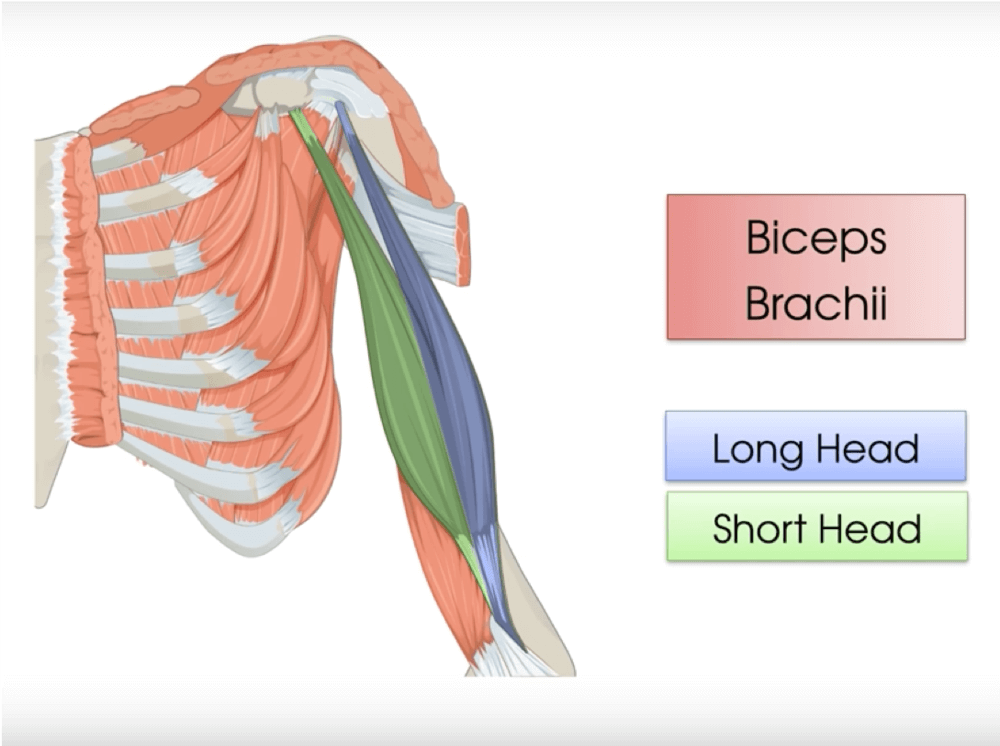
If someone has well-developed biceps and low enough body fat, you can usually see the difference between the long and short heads. They share the same muscle belly but have different upper attachment points before converging lower down.
To be anatomically specific, both heads originate at the scapula, but in different places. The long head attaches to the supraglenoid tubercle near the shoulder joint. The short head attaches to the coracoid process.
As you can see from the image, the short head sits more toward the inner side of the upper arm while the long head runs more along the outer side.
Both heads work together to flex the elbow and supinate the forearm. Because they cross the shoulder joint, they also assist with shoulder movement.
From an aesthetics standpoint, the long head contributes more to the biceps peak, while the short head contributes more to width.
A simple way to picture it is this: the short head helps form the base and thickness, while the long head helps create that higher, more dramatic flexed peak.
The Long Head of the Biceps
The long head of the bicep is a key muscle head for both strength and aesthetics. It sits on the outer part of the upper arm and has a big influence on the height and shape of the flexed bicep.
A lot of beginners know where the biceps are in general, but cannot tell you the difference between the short and long head. Once you understand that difference, your arm training usually gets a lot better.
The long head can be seen and felt more on the top and outer part of the bicep. It is what helps create that longer-looking arm and more pronounced peak.
Why It Is Crucial to Differentiate the Two Bicep Muscle Heads
Both bicep heads work together in almost every curl, but understanding how to bias one over the other helps you build more complete arms.
The long head usually needs more deliberate attention in casual lifters, especially when the biceps look flat rather than peaked.
That said, the short head matters too. Width and peak work together. You want both.
If your biceps are lacking peak, it usually is not because you need more random curls. It is more likely because you need better long-head exercise selection and better technique.
Long Head Bicep Workout Tips
To get the best results from a long head bicep routine, four main training variables matter most:
- Rep ranges and load
- Volume
- Tempo
- Rest intervals
a) REP RANGES:
Your biceps respond well to a mix of rep ranges, not just one.
For the best development, use all three of these buckets over time:
- 5-8 reps with heavy loads
- 8-15 reps with moderate loads
- 15-25+ reps with lighter loads
The load should take you to or near failure within the target rep range to be effective.
b) VOLUME:
A good weekly target is around 10-15 sets for the biceps. If you are more advanced and your biceps are lagging, 15-20 sets can work.
Note: These sets can be divided into 2-3 sessions throughout the week. Most lifters do well hitting biceps again after 2-3 days of recovery.
A simple way to divide that volume is:
- 50% lower reps with heavier loads
- 25% moderate reps with moderate loads
- 25% higher reps with lighter loads
Related: How Many Exercises, Sets, and Reps Should I Do Per Workout & Muscle Group
c) TEMPO:
Tempo matters more than most people think, especially for smaller muscles like the biceps.
The two most useful tempo approaches are:
- Fast concentric, squeeze at the top, slow eccentric
- Slow concentric, slow eccentric
The eccentric phase should usually be controlled and slow. That is where a lot of the tension and growth stimulus comes from.
Overall, more time under tension is generally good for hypertrophy, but a little variety in tempo can be useful too.
d) REST PERIODS:
Rest periods affect performance, fatigue, and total training quality.
- Short rest: around 30 seconds
- Moderate rest: around 60-90 seconds
- Long rest: around 2-5 minutes
Generally speaking:
- Lighter loads = shorter rest
- Moderate loads = moderate rest
- Heavy loads = longer rest
BICEP TRAINING MISTAKES:
If you want a better long head and a more noticeable peak, avoid these common mistakes.
1) Lifting Too Much Weight:
Heavy loads are useful, but only if you can move them with good form. If you cannot control the negative, complete the range of motion, or keep tension on the biceps, the weight is too heavy.
2) Not Focusing on Tension:
A strong mind-muscle connection helps. Think about the muscle shortening on the way up and lengthening on the way down.
3) Lack of Variation:
If you always use the same curl, same grip, and same setup, your body adapts. Vary your grips, elbow positions, and exercise choices over time.
4) Cheating Reps:
Cheating has a place now and then, but it should not be your default. If every curl turns into a full-body heave, your biceps are not getting the quality work they need.
Use strict form most of the time. Save slight body English for the occasional overload set.

WELL-ROUNDED BICEP ROUTINE WITH EMPHASIS ON THE LONG HEAD BICEP (BICEP PEAK WORKOUT)
You do not want a routine that only trains the long head forever. You want a balanced routine that emphasizes it a bit more if it is lagging.
Here are two solid bicep workouts that train both heads while giving the long head a little extra attention.
BICEP WORKOUT #1
| Exercise | Equipment | Sets | Reps | Rest |
| INCLINE BICEPS CURL | Dumbbells | 4 | 8-12 | 60-90 sec |
| HAMMER CURL | Dumbbells | 3 | 10-15 | 60-90 sec |
| WIDE GRIP PREACHER CURL | EZ Bar | 3 | 8-12 | 60-90 sec |
| CONCENTRATION CURL | Dumbbell | 4 | 8-12 | 30-60 sec |
BICEP WORKOUT #2
| Exercise | Equipment | Sets | Reps | Rest |
| CLOSE GRIP BARBELL CURL | Barbell | 3 | 5-8 | 90 sec |
| WIDE GRIP BARBELL CURL | Barbell | 2 | 5-8 | 90 sec |
| BAYESIAN CURL | Cable Machine | 2 | 5-8 | 60 sec |
| HAMMER CURL | Cable Machine w/ Rope Attachment | 2 | 8-12 | 60 sec |
| REVERSE GRIP CURL | Dumbbells | 2 | 10-15 | 60 sec |
These are two good bicep workouts that can be spread throughout the week.
For example, Workout 1 could be done after back day and Workout 2 could be done after a leg day.
FAQS
How much protein do I need to get big biceps?
If you train regularly to build muscle, your protein needs are higher than those of sedentary people. A practical range for lifters is around 1.6 to 2.2 grams of protein per kilogram of body weight per day.
Protein supplements can be convenient, but they are not required. The main goal is simply eating enough total protein consistently.
Are Supplements Needed for Quick Muscle Gains?
No. Supplements are optional. They can make it easier to hit your protein target, but they are not necessary for building bigger arms.
Whole food protein sources like lean meats, eggs, dairy, fish, soy, legumes, nuts, and high-protein snacks all work.
Related: Plant Protein vs Whey Protein Powder
How Much Time Does It Take for Biceps to Get Big?
That depends on training age, genetics, nutrition, recovery, and overall program quality.
Beginners often see noticeable growth within a few months. Intermediate lifters can still build impressive biceps, but progress is usually slower than those first “newbie gains.”
What you can control is training quality, nutrition, sleep, and consistency.

Common Bicep Tests for Injuries
If you are worried that your bicep may be injured, these are some of the more common tests and evaluation tools healthcare professionals may use.
1. Speed’s test:
A professional applies downward pressure while your arm is held in a specific position. Pain near the shoulder during this test can suggest biceps tendon involvement.
2. Yergason’s test:
This involves resisting forearm movement with the elbow bent. Pain can suggest irritation around the biceps tendon.
3. Physical examination:
A healthcare professional can often learn a lot by feeling the area and moving your arm through different positions.
4. CT scan:
If a standard exam is not enough, imaging may be used to look at the area more closely.
5. Magnetic resonance imaging (MRI scan):
An MRI gives a very detailed look at the soft tissues and can help identify tendon or muscle issues.
6. Biceps ultrasound:
Ultrasound can also be used to evaluate the tendon and surrounding structures.
Common Injuries Associated With the Bicep
Because we use the biceps so often in training and daily life, the muscle and its tendons are prone to strain and overuse issues.
- Bicep strains: These happen when the muscle is overloaded and some fibers tear. Pain, swelling, and tightness are common signs.
- Partial tendon tear: This may happen near the shoulder or elbow. Pain, swelling, and weakness are common.
- Complete tendon tears: These are more severe and often involve a sudden pop, pain, and loss of strength.
- Popeye deformity: This visible bulge can happen when the tendon recoils after tearing.
Treatment for Bicep Injuries
Some bicep injuries improve with time and conservative care, while others need medical evaluation. For acute injuries during the first 48-72 hours, the basics usually include:
- Rest the injured shoulder, arm, or elbow
- Use ice for short periods to reduce swelling
- Use light compression if appropriate
- Keep the limb supported and avoid aggravating movements
If you hear a pop, notice visible deformity, or lose strength quickly, get it checked out by a medical professional.
Conclusion
If your goal is a better bicep peak, the long head deserves focused attention.
The good news is that you do not need dozens of new exercises. Most of the time, better long head development comes down to smarter grip selection, better elbow positioning, and enough quality training volume.
Use the exercises above, apply progressive overload, and be patient. Over time, your long head will catch up and your biceps will look fuller, taller, and more complete.
Now that you have learned how to train the long head of the bicep, it is time to dive into the best Short Head Bicep Exercises.
Related:
2 comments
What’s the best way to stretch the long head of bicep? Thanks
Nice article. Helps me a lot.