


Is there anything more satisfying than building quads that actually look trained? Thick, defined quads do not just improve how your legs look. They also help you squat better, move more powerfully, and support healthier knees.
If your goal is bigger, stronger, more defined thighs, you need the right exercises and the right training approach. That is where this guide comes in.
Take Your Fitness To The Next Level


Below, we break down the 13 best quad exercises for muscle growth, strength, and better lower-body performance. We will also cover:
- Quadriceps anatomy and function
- Benefits of strength training the quads
- Important training variables
- The 13 best quad exercises
- How often to train the quadriceps muscles
Read on. Your best quad gains may be closer than you think.

Why Quad Training Matters
Your quads do a lot more than help fill out a pair of shorts. They are heavily involved in walking, running, jumping, squatting, lunging, climbing stairs, and standing up from the floor or a chair.
Well-trained quadriceps can help you:
- Build stronger, more athletic legs
- Improve squat and lunge performance
- Support knee stability
- Improve sprinting and jumping power
- Create more balanced lower-body development
WHAT ARE THE QUAD MUSCLES?
The quadriceps group contains four muscles in the front of the thigh: vastus lateralis, vastus medialis, vastus intermedius, and rectus femoris.
- Vastus Lateralis: Found on the outer thigh, the vastus lateralis is the largest of the four quad muscles. Its primary job is to extend the knee, enabling the lower leg to move forward, and it also helps stabilize the knee joint.
- Vastus Medialis: The "teardrop" quad muscle sits toward the inner side of the thigh near the knee. It helps with knee extension and plays a major role in helping keep the kneecap aligned.
- Vastus Intermedius: This quad muscle runs between the vastus lateralis and vastus medialis and is the deepest of the quad muscles. The vastus intermedius works with the rest of the quad group to extend the knee.
- Rectus Femoris: This is the only quad muscle that crosses both the hip joint and knee joint. That means it helps with both hip flexion and knee extension. The rectus femoris is especially important in sprinting, kicking, and squat variations where the torso stays more upright.

BENEFITS OF STRONG QUADRICEPS MUSCLES
Strong quadriceps are essential for:
- Performing everyday activities: Due to their role in knee extension and hip flexion, activities like walking, running, standing up, and taking the stairs depend heavily on the quads.
- Protecting the knee: The vastus medialis and vastus lateralis help keep the kneecap tracking well during movement.
- Preventing and treating common issues: Strengthening the front thigh muscles can help reduce the risk of problems linked to weak quads, including patellofemoral stress syndrome, IT band friction syndrome, and patellar tendon irritation.
- Increasing power: Stronger, bigger thighs improve sprinting, jumping, squatting, and lower-body force output in general.
- Improving aesthetics: Thick, developed quads can completely change how your lower body looks.
CAN YOU ISOLATE YOUR QUADS?
You can emphasize the quadriceps, but total isolation is not really possible or necessary. In most lower-body movements, the glutes and hamstrings will still contribute. The good news is that you do not need pure isolation to build impressive quads. You just need exercises that make the front thigh muscles do most of the work.
WHAT ARE THE BEST QUADRICEPS EXERCISES?
The best quadriceps exercises are the ones that let you position your body in a way that emphasizes knee extension and keeps more of the load on the front of the thighs. That usually means squats, lunges, leg presses, step-ups, and leg extensions.
Small changes in positioning can shift more stress to the quads. For example:
- Lower foot placement on the leg press tends to shift more work to the quads
- Heel elevation during squats and split squats can make it easier to stay upright and bias the quads more
- Front-loaded squats usually involve the quads more than back-loaded versions
TRAINING VARIABLES:
There are several key variables to keep in mind when targeting the quadriceps, including load position, body position, stability levels, and equipment options.
- Load positioning: Changing where the load sits can dramatically affect quad involvement. Moving the load to the front of the body, as in front squats and goblet squats, usually shifts more work to the quads because it encourages a more upright torso.
- Body positioning: Good technique matters for both safety and results. Heel elevation, torso angle, and shin angle can all influence how much work lands on the quads. Keeping the torso more upright and allowing the knees to travel forward can help shift more stress to the front thighs.
- Stability levels: Machine-based exercises give you more stability, which means you can usually push the quads harder without balance being the limiting factor. Less stable exercises such as split squats and step-ups are also valuable because they challenge coordination and force the legs to stabilize under load.
- Equipment: Bodyweight, dumbbells, kettlebells, barbells, and machines all have a place in quad training. Machines help you safely pile on volume. Barbells allow for heavier squats. Dumbbells are versatile and beginner-friendly. Bodyweight movements can still be brutal when programmed correctly.

13 BEST QUAD EXERCISES
Here are the all-time best exercises to build big, strong quads.
1. Barbell Back Squat

This move emphasizes 3 of the four quadriceps muscles, the vastus lateralis, vastus medialis, and vastus intermedius. This how-to explains how to do a high bar back squat, but another option is the low bar back squat. In the low-bar squat, the bar lies across the shoulder blades. While research has found minimal differences between quad activity in the two bar positions, a study did find the rectus femoris, vastus lateralis, and vastus medialis were activated more in the eccentric part of the low-bar squat1. Switching the bar position up is a great way to get the rectus femoris more involved with this exercise.
How to:
- Take the bar off the rack by resting it on the backside of the top of the shoulders. Taking a few steps back, place the feet shoulder-width apart with toes pointing forward or out slightly. The spine remains straight, the chest upright, and the shoulder blades retracted. Look forward.
- Flex the hips and knees to sit back. Continue lowering until the hip crease is below the knee. Keep the weight in the heels, and the knees in line with the toes.
- Simultaneously straighten the knees and hips as you push upward, back to standing.
- Take a deep breath and repeat.
Rep range: 3-5 sets of 8 to 12 reps per set
2. Front Squat

The front squat form is similar to the back squat but with one main difference. The bar is in front of the chest rather than behind the neck. The bar adjustment further emphasizes the quadricep muscles, of which all four are activated. Research comparing the back and front squats found that the vastus medialis and vastus lateralis are more activated when holding the bar in front2.
How to:
- With hands shoulder-width apart and elbows pointed forward, grab the bar with palms facing up, resting on the fingertips. Lift the bar off the rack, stepping back.
- Position the feet slightly wider than shoulder-width, pointing the toes forward or slightly out. Keep the spine straight and trunk upright. Gaze straight ahead.
- Bend at the hips and knees, sitting back. Lower until the crease of the hips is below the top of the thighs. Keep the knees in line with the toes.
- Straighten the hips and knees, pushing upward to standing.
Rep range: 3-5 sets of 6-12 reps per set
3. Hack Squat

The hack squat is a machine exercise great for beginner lifters, those looking to target the quads, and those with back issues. The machine helps stabilize the back during movement. While this exercise activates all of the quad muscles, the vastus medialis works particularly hard. Hello, teardrop definition.
How to:
- Load the machine with the desired weight amount.
- With the back toward the machine, place the feet shoulder-width apart, and the shoulders and back against the pads.
- Releasing the safety handles, lower down by bending the hips and knees until they reach a 90-degree angle.
- Straighten the hips and knees, pushing upward to return to the starting position.
Rep range: 3 sets of 10-12 reps per set
If you don't have access to a hack squat machine, here are some good alternatives to the hack squat that work the same muscles.
4. Split Squat

You can use bodyweight, dumbbells, or a barbell for the split squat. And if you frequently work out at home, consider the split squat to be essential to your at home quad workouts.
There are different ways to place your body in this exercise to target different lower body muscles. To emphasize the quadriceps, keep the torso and shin upright in the movement or keep the torso upright and the shin forward.
How to:
- Hold a dumbbell in each hand, set up the barbell on the back tops of the shoulders, or place the hands on the hips. Begin by standing with feet underneath the shoulders. Take a wide step forward with one foot. The toes point forward, and both heels remain planted on the ground. Keep the torso upright.
- Bend at the knees, lifting the back heel off the ground as the weight shifts into the front heel. Continue lowering until the back shin and front thigh are parallel with the ground.
- Push through the front heel using the front leg to drive the body upward.
Rep range: 3-4 sets of 8-12 reps on each leg
5. Bulgarian Split Squat

The Bulgarian split squat uses the same form as the split squat, except you'll elevate the back foot. This change is a great progression from the split squat as it puts your balance and stability to the test. You can use your body weight, one or two dumbbells, or a barbell. The vastus medialis and rectus femoris activity are very high in this movement, with moderate activation from the vastus lateralis3.
How to:
- Stand in front of a bench, chair, or another elevated surface that is stable and approximately knee height. Keeping the feet hip distance apart, move into a forward lunge position by taking a wide step forward. Elevate the back foot on your stable surface. Place the top of the back foot on the bench. Or, flex the ankle, placing the toes on the bench and lifting the heel. Keep your knees slightly bent.
- Bend the knee, keeping it in line with the foot, until the front thigh is parallel to the ground. The hips should hinge forward slightly. The chest stays upright; look straight ahead. Keep the weight on the front leg.
- Straighten the body, returning it to an upward position, by driving through the front leg.
Reps: 3 sets of 8-12 reps per leg
6. Forward Lunge

The rectus femoris is the primary quadricep mover of the forward lunge; however, research shows that the vastus lateralis and vastus medialis also put in significant work4.
How to:
- Stand with feet hip-width apart, and hands either on the hips or holding a barbell or dumbbells.
- Step forward with the right foot, bending at the knees, lowering the body until both form 90-degree angles. The chest remains upright. The back heel lifts off the ground, placing the weight on the front leg.
- Push off the right foot, straightening the knees as the right leg returns to the starting position.
Reps: 3 sets of 8-12 reps per side
Have knee pain? Check out these lunge alternatives for bad knees.
7. Sissy Squat

Warning: This quad-isolating exercise’s name is extremely misleading. The sissy squat does an exceptional job hitting every quad muscle and can target the rectus femoris, something not all lower-body movements can do. Unless you’re an advanced lifter familiar with the sissy squat, you don't need to add weights. Just your body weight will be more than enough.
How to:
- Begin in a standing position with feet hip-width apart, legs straight.
- Keep the hips extended, and raise the heels. If you’re able to maintain balance, extend your arms in front of you or place them on the hips. If new to this movement, consider holding onto something at first.
- Lower into a squat, pushing the knees forward and keeping the upper body in a straight line. Maintain hip extension the entire time.
- Continue lowering until you can no longer maintain proper form.
- To return to standing, extend the knees.
Reps: 3 sets of 6 reps each
8. Close Stance Leg Press

A narrow stance on the leg press will put the outer thighs to work, meaning the vastus lateralis is highly activated. By altering your foot positioning, you can emphasize certain muscles of the lower body. Keeping your feet shoulder-width apart will target the entire lower body, while a wide stance will hit the inner thighs. High foot placement targets the glutes and hamstrings, and lowering the feet will target the entire quad group. And if you're concerned the leg press isn't as effective as other moves, compare the leg press vs. squat, and you'll see it offers plenty of value.
How to:
- Sitting at a leg press machine, plant the feet on the foot plate, keeping the feet less than shoulder-width apart. The feet should be less than 3 inches apart, with the toes pointing slightly out. The back remains on the pad at all times.
- Lowering the safety bars, press the footplate up away from the torso until the legs are straight.
- Lower the footplate to the torso by bending the knees, continuing until the upper and lower legs form a 90-degree angle.
- Push through the heels of the feet as you straighten the knees and return the platform to the starting position.
Reps: 3-4 sets of 8-12 reps
9. Single-Leg Leg Press

This version of the leg press also does a great job targeting the outer thigh, meaning your vastus lateralis will be strongly activated. Use this quad exercise to observe whether muscle imbalances exist between the two legs.
How to:
- Sitting at a leg press machine, plant one foot on the footplate, keeping the other on the floor or straightened underneath the platform. Press the footplate away from the torso, releasing the leg press from the locked position.
- With your working leg straight, bend at the knee, lowering the footplate or sled toward your torso, continuing until your knee is almost touching the chest.
- Extend the knee, pressing the footplate away to return to the starting position. Keep the knee in line with the toes.
Reps: 2-3 sets of 8-12 reps per leg
10. Leg Extension Machine

Leg extensions are one of the cleanest ways to hammer the quads directly. They heavily involve the rectus femoris and vastus intermedius while still hitting the other quad muscles. Now imagine pairing them with some stair climbing. The benefits of the stair climber are endless, and the combo makes for a nasty quad finisher.
How to:
- Sit at the leg extension machine. Place the legs under the pad, adjusting it so it sits on top of the shins and above the feet. Set the machine to your desired amount of weight. Place the hands on the sidebars.
- Lift the weight by straightening the legs. Keep the back on the backrest.
- Lower the weight back to the starting position by bending the knees.
You can also do these unilaterally, working one leg at a time.
Reps: 3 sets of 8-12 reps
No leg extension machine? Here are the best leg extension alternatives.
11. Step Ups

If you need a slightly easier variation of this exercise, ditch the dumbbells and use body weight. If you want to make it harder, only use one dumbbell, placing it in the hand opposite the working leg. All of the quadriceps muscles are activated in this movement, but research shows this exercise emphasizes the vastus lateralis the most5.
How to:
- Stand by a bench that's just under knee height, holding a pair of dumbbells, with arms extended by your sides. Place the right foot on the bench, with the hip, knee, and ankle bent 90 degrees.
- Keep the chest upright with shoulders rotated back, and begin to extend the right knee as you drive the body up with the right leg. Elevate the left foot as your body moves upward.
- You can tap the left foot on the bench before lowering back down on the right leg, or keep it elevated, maintaining balance on the right as you lower back down by bending the right knee. Tap the left foot to the ground, and then quickly raise the body upward again, using the right leg.
Reps: 3 sets of 8-12 reps on each leg
12. Goblet Squats

The goblet squat is your go-to if you’re struggling with squat form, bad posture, or inflexibility. Because you hold the weight in front, the hips open more than in other squat variations to enable you to lower between the legs. No quad muscle will go ignored with this move, but the vastus medialis gets the most attention.
How to:
- Standing with feet slightly wider than shoulder-width and toes pointed forward, hold a kettlebell at chest height with elbows tucked into the sides. The feet are wider than other squat variations, and the toes point outward slightly. It should sit close to the chest. Retract the shoulder blades. You can also use a dumbbell, holding it vertically against the chest.
- Bend the knees and sit back in the hips as you lower into a squat. Keep the chest upright and the back straight. The feet remain flat on the floor. Lower as far as you can.
- Push through the heels as you extend the knees and return to standing.
Reps: 3-5 sets of 10-12 reps
13. Box Jumps or Jump Squats
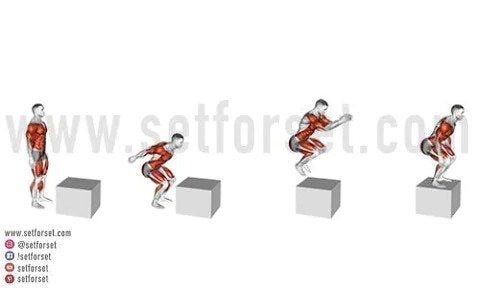
If the box jump is new to you, start with a shorter box, working your way up to a taller one as you perfect the move. Due to the high energy required for this exercise, place it at the beginning of your routine when your legs are fresh. Every quad muscle must work to make this plyo move possible, with a special emphasis on the rectus femoris.
How to:
- Stand facing a box, with the feet about six inches away from the box and hip distance apart. Bend the knees and hips slightly.
- Bend at the knees, pressing the hips back while swinging the arms behind you.
- Pushing off the balls of the feet, jump into the air, swinging the arms up and forward. Fully extend the knees and hips to get as much height as possible with the jump.
- At the top of the jump, bend the hips and knees, drawing them forward to land on top of the box.
- Land softly on top of the box with both feet simultaneously. Bend the knees and hips when landing, and land with the feet about hip distance apart.
- Step off the box, and repeat the movement.
Reps: 3-4 sets of 5 jumps

HOW OFTEN SHOULD YOU TRAIN YOUR QUADRICEPS MUSCLES?
For most lifters, training the quads twice per week is a very practical setup for hypertrophy and strength. Weekly volume matters a lot, so instead of cramming everything into one brutal leg day, it usually makes more sense to split your quad work across two sessions.
A good starting target is around 10 hard sets per week for the quads, spread across two lower-body days. More advanced lifters may benefit from more, but that is a strong baseline for most people. Do not train them on back-to-back days. Give them time to recover and come back stronger.

Prepare to maximize your gains with our exclusive 12-week hypertrophy training program. Choose between a 4 or 5 day training split and gain 2-12 pounds of muscle over 90 days...
PARTING TIPS FOR QUAD GAINS:
Following these quad exercises will set you on a path for thick, muscular quads. Here are a few final tips that will help even more.
- Do not skimp on squat depth and lunge range of motion. Quality reps matter.
- Eat enough protein. Anywhere from 1.6 to 2.2 grams per kilogram of body weight is a strong target for supporting muscle growth and recovery.
- Rest and recover. Give the quads about 48 hours between hard training sessions when possible.
- Track your lifts. Bigger quads usually come from progressive overload, not random workouts.
If you need more volume in your quad training, use these dumbbell quad exercises for even greater quad growth.
More Leg Exercise Content:
References:
- Murawa M, Fryzowicz A, Kabacinski J, et al. Muscle activation varies between high-bar and low-bar back squat. PeerJ. 2020;8:e9256. doi:10.7717/peerj.9256
- Yavuz HU, Erdağ D, Amca AM, Aritan S. Kinematic and EMG activities during front and back squat variations in maximum loads. Journal of Sports Sciences. 2015;33(10):1058-1066. doi:10.1080/02640414.2014.984240
- Aguilera-Castells J, Buscà B, Morales J, et al. Muscle activity of Bulgarian squat. Effects of additional vibration, suspension and unstable surface. PLOS ONE. 2019;14(8):e0221710. doi:10.1371/journal.pone.0221710
- Park S, Chung C, Park J, et al. Comparative Analysis of Lunge Techniques: Forward, Reverse, Walking Lunge. Published 2016.
- Does the relative muscle activation of the vastus medialis, rectus femoris, and vastus lateralis during the various activities change in relation to the quadriceps angle? Accessed via Unbound Medicine.
- DiFrancisco-Donoghue J, Werner W, Douris PC, McKenna RF. Comparison of once-weekly and twice-weekly strength training in older adults. British Journal of Sports Medicine. 2006;41(1):19-22. doi:10.1136/bjsm.2006.029330
- Schoenfeld BJ, Ogborn D, Krieger JW. Effects of Resistance Training Frequency on Measures of Muscle Hypertrophy: A Systematic Review and Meta-Analysis. Sports Medicine. 2016;46(11):1689-1697. doi:10.1007/s40279-016-0543-8
- Bryanton MA, Kennedy MD, Carey JP, Chiu LZF. Effect of Squat Depth and Barbell Load on Relative Muscular Effort in Squatting. Journal of Strength and Conditioning Research. 2012;26(10):2820-2828. doi:10.1519/jsc.0b013e31826791a7
- Stokes T, Hector A, Morton R, McGlory C, Phillips S. Recent Perspectives Regarding the Role of Dietary Protein for the Promotion of Muscle Hypertrophy with Resistance Exercise Training. Nutrients. 2018;10(2):180. doi:10.3390/nu10020180
0 comments