


If your back is still “kinda there” instead of “whoa,” there’s a decent chance you’ve been ignoring the T-bar row. Big mistake. T-bar rows are one of the best moves you can do to build thickness and strength across your entire back. And yes, we’re saying that while fully respecting the bent-over row, which is a classic. But for a lot of lifters, the T-bar row is simply easier to load heavy, easier to feel in the right muscles, and easier to repeat week after week without your lower back tapping out first.
Take Your Fitness To The Next Level


Here’s what we’ll cover:
- What is the T-bar row?
- Benefits of T-bar rows
- T-bar row muscles worked
- How to perform the T-bar row correctly
- Grip variations and what they emphasize
- How to program the T-bar row for a bigger back
Time to upgrade from “small back” to “someone definitely rows.”

Quick Answer
The T-bar row is a loaded rowing movement performed on a pivoting bar or machine. It trains the entire back, especially the lats, mid-back, traps, and rear delts, while also hitting the biceps and requiring core and spinal erector stability. It’s a go-to for back thickness because it’s stable enough to load heavy but still demands real control.
Key Takeaways
| Goal | Best rep range | Top cue |
|---|---|---|
| Strength | 4–6 reps | Drive elbows back, pause on chest |
| Mass | 8–12 reps | Controlled stretch at bottom |
| Back “feel” and pump | 12–15 reps | Keep torso angle consistent |
What Is The T-Bar Row?
The T-bar row is a compound movement performed with a pivoting bar setup. Most gyms have a dedicated T-bar machine with a platform to stand on, a bar fixed at one end, and handles on the other end (often multiple handle options). You load plates on the sleeve, lift the bar off the stop, hinge forward, and row the load into your torso.

It’s kind of the best of both worlds: more stable than a pure free-weight row, but not as locked-in as something like a Smith machine. The bar moves on an arc, but your body still has to control position, bracing, and the row path. That means you can usually push load and volume without your form instantly turning into a yard sale.
Standing vs Chest Supported T-Bar Row Machines
Some machines are standing only, while others have a chest pad. The standing version can let you move more weight because you can brace and use a bit more total-body tension. The chest-supported version usually forces stricter reps and reduces lower-back fatigue, which is great if you want your back to be the limiter, not your erectors.

Landmine T-Bar Row With Barbell Set Up
No T-bar machine? You can still do T-bar rows with a landmine setup (or the “barbell in the corner” classic) plus a row handle attachment. Same idea, same benefits, same back growth potential.

Note: You can even do it without a handle by gripping the bar just behind the sleeve. Not ideal for everyone, but it works. No excuses.

Benefits Of T-Bar Rows
T-bar rows are a staple for a reason. Here are the biggest wins you get from making them a regular part of your back training.
1) Great For Both Mass And Strength
Some exercises lean more “strength” or more “pump.” T-bar rows sit right in the middle. You can load them heavy for low-rep strength work without the chaos that can happen with sloppy barbell rows. And you can also run higher volume and different grips for hypertrophy.
2) Multiple Grips, Slightly Different Emphasis
Different handles let you change the feel without changing the exercise. That means more variety, fewer overuse issues, and better overall back development.
- Overhand grip: strong all-around back builder; usually more upper-back and rear-delt friendly.
- Underhand grip: often lets you move more weight and brings the biceps in harder; many lifters feel more lower-lat involvement too.
- Wide grip: often increases upper-back emphasis (rear delts, mid traps, rhomboids) and can reduce biceps dominance for some.
- Neutral grip: typically the strongest and easiest on elbows; great for heavy sets and clean reps.
You can even use grips within the same set as a “grip drop set.” Example: hit reps with a harder grip, then switch to a stronger grip and keep going without changing weight.
3) Easy To Load And Unload
It sounds minor until you’re gassed. The elevated loading sleeve makes plate changes fast. That makes it perfect for drop sets, back-off sets, and “one more plate” moments that actually build muscle.
4) Back-Friendly Compared To Some Free-Weight Rows
Because the bar follows an arc, many lifters find it easier to maintain tight positioning compared to a heavy bent-over row. You still need to brace and hinge properly, but the setup tends to reduce the chances of turning a row into a lower-back endurance event.
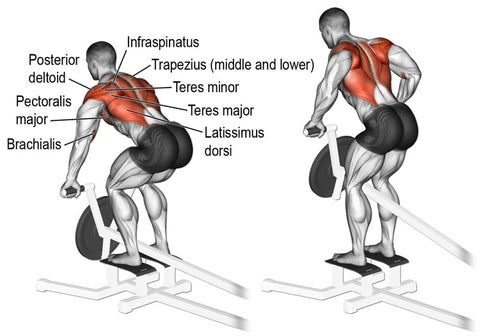
T-Bar Row Muscles Worked
T-bar rows train basically your entire back and your biceps. Your spinal erectors work isometrically to hold the hinge position (especially on standing machines), while the prime movers are the lats, traps, rhomboids, and rear delts. Your biceps and forearms assist with elbow flexion and grip.
- Lats
- Traps (upper, mid, and lower depending on grip and torso angle)
- Rhomboids + mid-back
- Rear delts
- Erector spinae (isometric bracing)
- Biceps + forearms
How To Perform T-Bar Rows
The movement is straightforward, but great reps come down to bracing, torso angle, and controlling the stretch at the bottom.
- Load the T-bar with your desired weight.
- Stand on the platform with feet about shoulder width apart and the bar between your legs.
- Hinge down like a deadlift, grab the handles, and create tension through your upper back before you lift.
- Stand up with the load to unrack it, then hinge forward again. Keep knees slightly bent and hips back.
- Set your torso angle so it matches the bar angle as best you can. This helps keep the row path consistent and keeps the rep honest.
- Row by driving elbows back. Think “elbows to hips” if you want more lat, or “elbows out” if you want more upper-back.
- Pull to your lower chest or upper stomach depending on your grip and machine setup, then pause briefly.
- Lower until your arms are fully extended and you feel a stretch, without letting your torso rise up.
Top form cues: keep your torso angle consistent, keep your chest “proud,” and make the back do the work by focusing on driving the elbows back rather than curling the handle.

How To Program The T-Bar Row
The T-bar row is flexible. You can run it heavy for strength, moderate for mass, or higher-rep for a nasty back pump. Here are two simple approaches that work.
a) To Build Strength
Use challenging loads that allow clean reps. A practical target is a weight you can do for about 4–6 reps with good form.
- Sets/Reps: 4–5 sets of 4–6
- Rest: 2–3 minutes
- Grip suggestions: neutral or underhand for heavier loading, rotating in overhand to keep balance
b) To Build Mass
Use a load that lets you control the bottom stretch and still hit solid reps without turning it into a jerk-fest.
- Sets/Reps: 3–4 sets of 8–12
- Rest: 60–120 seconds
- Grip suggestions: overhand and neutral are money here; wide grip can be a good upper-back emphasis option
Want a nasty finisher? Do a grip drop set without changing weight:
Wide Grip → Overhand Grip → Underhand Grip → Neutral Grip
Same weight, progressively stronger grips, and your back gets cooked without you wasting time stripping plates.
If you really want to level up your back, training it twice per week is a strong move. Use one day as heavier strength-focused T-bar rows, and the other day as moderate-to-high rep hypertrophy work.

The T-Bar Row Is The Back Exercise You’re Missing
T-bar rows are simple, effective, easy to load, and ridiculously good for building back thickness. If you want a bigger back, stop treating this like an optional accessory and start treating it like a staple. It belongs in a serious back training routine.
And if you genuinely cannot do them right now, we’ve got you covered with alternatives to T-bar rows. You can also lean into dumbbell work with these dumbbell back exercises.

Prepare to maximize your gains with our exclusive 12-week hypertrophy training program. Choose between a 4 or 5 day training split and gain 2-12 pounds of muscle over 90 days...
1 comment
Thanks for the information very helpful for making gains in performance and growth!