


When was the last time you used a weight bench for ab work?
A bench is one of the most underrated tools for training your core because it lets you change leverage, increase range of motion, and make simple movements harder without needing fancy equipment. If you are already parked on a bench between sets, you might as well get some quality ab training in too.
Take Your Fitness To The Next Level


In this guide, we will cover the main abdominal muscles, the benefits of training your abs, and 21 of the best bench ab exercises you can do with a flat bench, adjustable bench, or decline bench. You will also get a simple bench ab workout you can plug into your week.
Quick Answer
Yes, benches are great for ab exercises, especially flat and adjustable benches. The bench changes your body position so you can:
- Increase or decrease difficulty (flat vs decline vs elevated planks).
- Target the abs through different functions (flexion, anti-extension, anti-rotation, lateral stability).
- Progress easier by increasing range of motion or adding load (dumbbell, plate, band).
If your goal is visible abs, remember: you build the muscle with training, but you reveal it with overall body fat reduction. Bench ab work helps with strength and thickness, not spot fat loss.
| Key Takeaways | What to do |
|---|---|
| Train abs like other muscles | Use control, full ROM, and progressive overload (tempo, reps, load, or harder variations). |
| Use multiple core functions | Include spinal flexion, anti-extension, lateral stability, and rotation work each week. |
| Bench makes progression easier | Decline versions and elevated planks increase difficulty without needing machines. |
| Do not chase neck pain | Keep ribs down, chin neutral, and avoid pulling your head during crunches and sit-ups. |
| Abs do not burn belly fat | Combine training with nutrition and full-body strength work for visible definition. |

Table of Contents
- What are the abdominal muscles and their functions?
- Are benches good for ab exercises?
- What is the best ab exercise for a 6-pack?
- Benefits of ab exercises
- 21 best weight bench ab exercises
- How to program bench ab exercises
- Ab bench workout
- Will ab exercises help me lose stomach fat?
- Can you work upper and lower abs separately?
- FAQ
What are the abdominal muscles and their functions?
The major muscles in the abdomen are the rectus abdominis (the “six-pack” muscle), the transverse abdominis (deep core stabilizer that wraps around your torso), and the obliques (muscles on the sides of your abdomen). Each plays a different role in movement and stability.
Transverse Abdominis: The transverse abdominis (TVA) is the deepest abdominal muscle layer. Think of it like a corset that helps brace the trunk, stabilize the pelvis and spine, and support internal organs. A strong TVA improves core stiffness and helps you brace for heavy lifting.
Obliques: The obliques are made up of the internal and external obliques. They help with rotating, bending, and stabilizing the torso, which matters for everything from sports to carrying groceries without twisting your back.
Internal Oblique: The internal obliques sit beneath the external obliques and assist in trunk rotation, side bending, and maintaining abdominal wall tension. Strong internal obliques can also help lower the risk of issues like abdominal hernias by supporting abdominal pressure mechanics.
External Oblique: The external obliques are the more superficial side abs. They help rotate the trunk, bring the ribcage down (trunk flexion), and stabilize the torso during movement.
Rectus Abdominis: The rectus abdominis is the front abdominal muscle most people associate with “abs.” Its primary job is trunk flexion (crunching up), but it also helps stabilize the pelvis and support abdominal pressure during forced breathing.
Are benches good for ab exercises?
Yes, benches are great for abs, but the type of bench matters. Flat benches, adjustable benches, and decline/ab benches are the most useful. Some Olympic benches work too, but not all designs allow good ab positioning.
Flat Bench
This is the most common bench in a gym. It is just a stable platform, which makes it surprisingly useful for core work (crunch setups, reverse crunches, seated tucks, flutter kicks).
Olympic Weight Bench
These benches are often wider and longer and may include attachments like a bench press rack, a squat rack, or leg/knee pads. Some models let you lock in for decline ab work, but it depends on the setup.
Preacher Curl Bench
Mainly for preacher curls. Not much core utility here.
Ab Bench
Built for ab exercises and often usable for decline pressing too. Many have rollers to lock your legs for decline sit-ups and crunches. If you are shopping, see: Best Sit Up Benches.
Adjustable Bench
Adjustable benches let you change angles for incline or decline. That means you can progress exercises without changing equipment, which is a huge win for core training.
If you want to learn more, check out our roundup of the Best Weight Benches available today.
What’s the best ab exercise for a 6-pack?
The best ab exercises for a “6-pack” target the rectus abdominis hard and consistently, but genetics influence whether you have a 4-pack, 6-pack, or 8-pack. Regardless, training the abs can make them thicker and more prominent at a given body fat level. For a deep dive: 4 pack abs vs. 6 pack vs. 8 pack.
In an ACE-sponsored study, researchers compared common ab exercises using EMG. The bicycle crunch, knee raise on a Captain’s Chair, and stability ball crunch ranked highly for rectus abdominis activation. The top oblique activators included the Captain’s Chair, bicycle crunch, and reverse crunch.
Bench ab exercises can replicate similar patterns and add progression by changing leverage and range of motion.
Related: Abs Explained: Can You Have A 10 Pack?
Can planks give you a 6-pack?
Planks alone usually will not build a standout six-pack, but they are excellent for core stability and “flattening” the midsection by improving abdominal bracing. They also train shoulders, glutes, and legs. Use planks alongside flexion-based work (crunch and reverse crunch patterns) and progressive resistance for the best results.
Related: 29 Best Plank Exercises for Core Strength & Stability
Can I do ab exercises every day?
Many people can train abs 3 to 5 days per week, and some can handle daily ab work if volume and intensity are appropriate. The key is recovery and loading. If you are doing hard weighted ab training (like loaded decline sit-ups), you may need more rest. If you are doing light bodyweight activation work, you can usually train more frequently.
If your goal is thicker abs, add resistance and progress over time using progressive overload.
Benefits of ab exercises
Besides aesthetics, strong abs matter for how you move, lift, and feel day to day.
- Stronger core: Better trunk stability for daily tasks and training.
- Less back discomfort: Strong abs support pelvic control and reduce how much your lower back has to compensate.
- Better athletic performance: More efficient force transfer through the torso for running, throwing, jumping, and cutting.
- Improved posture: Core stability helps keep your torso stacked and upright.
- Better balance and coordination: Core strength helps you stay stable on uneven ground and during dynamic movement.
- Carryover to big lifts: Bracing during deadlifts, squats, and overhead press improves stability and can reduce injury risk.
Related: 5 Exercises to Relieve Lower Back Pain
21 Best Weight Bench Ab Exercises
Below are 21 bench ab exercises and variations. Use the ones that match your equipment and current level. Focus on control and clean reps over speed.
1. Bench Crunch
The bench crunch is an easier variation of the crunch because you don’t have to suspend your legs in the air. You’re able to use the bench as a crutch so you can purely focus on the contraction of the abdominal muscles.
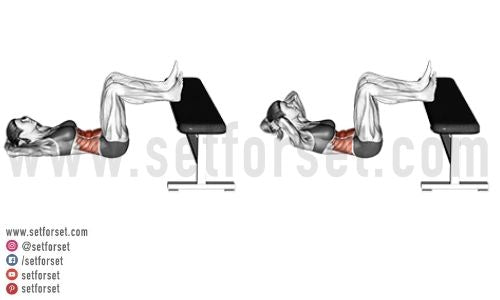
How To:
- Lie down on the bench
- Bring your hands up behind your head then clasp your fingers together
- If your bench has the leg holders then bring your legs up into position. If you’re using a simple flat bench then bring your legs up with your knees bent at 90 degrees and your lower legs are parallel with the bench
- Crunch your body up by contracting your abs but keep your lower back in constant contact with the floor
- Slowly return to starting position
- Repeat for desired number of reps
Note: Don’t pull up with your hands on the back of your head, use only your ab muscles to crunch your body up towards your legs.
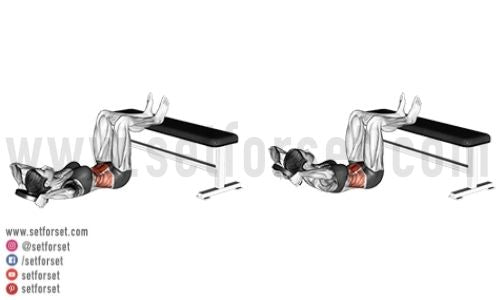
2. Weighted Floor Crunch
This is the same movement as the bench crunch except for the added resistance. You can hold a weight plate, dumbbell or kettlebell. Follow the same cues from the crunch except you'll have the weight behind your head. Use a load you can control and avoid straining your neck.
3. Crunch Hold
The crunch hold is the same exercise as the bench crunch except you will pause at the top to get the benefits of an isometric contraction. This version puts constant tension on the abs. Track your hold time and try to progress week to week.
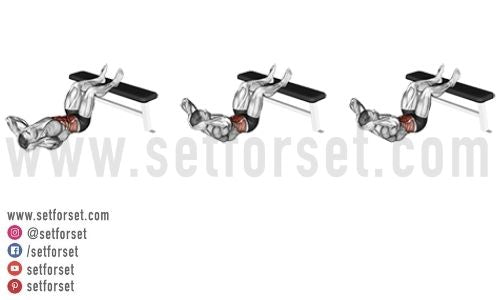
How To:
- Lie down on the floor perpendicular to the bench
- Lift your legs up then place your calves on the bench
- Bring your hands up behind your head then clasp your fingers together
- Crunch your body up by contracting your abs but keep your lower back in constant contact with the ground.
- Hold at the top of the movement for as long as possible
- Slowly lower to starting position
- Repeat desired reps
Note: Use only your ab muscles to hold yourself in the crunch position.
4. Oblique Crunch
The oblique crunch engages the obliques by lifting and rotating your upper body toward one side. Since twisting and bending show up in real life, it’s smart to include oblique-focused work.
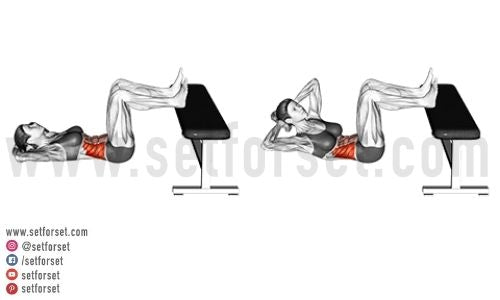
How To:
- Lie down on the floor perpendicular to the bench
- Lift your legs up then place your calves on the bench
- Bring your hands up behind your head then clasp your fingers together
- Crunch your body up by contracting your obliques then rotating the trunk so that your elbow points towards your opposite knee but keep your lower back in constant contact with the ground.
- Slowly lower to starting position
- Repeat desired reps alternating to each side
Note: Focus on squeezing your obliques at the top of the movement.
5. Decline Crunch
You’ll need a bench that can be set to a decline. This version is more challenging than a regular crunch because you are working against gravity.
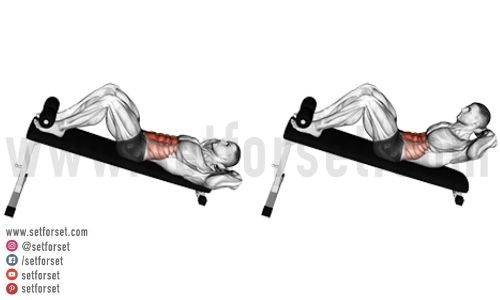
How To:
- Get into position on the ab bench with your feet looked into place and your back against the bench
- Bring your hands together behind your head
- Crunch your body up towards your feet while maintaining contact with your lower back to the bench
- Slowly return to starting position
- Repeat for desired reps
Note: Focus on the contraction of your abs to bring your upper body up towards your feet.
6. Decline Bent Leg Reverse Crunch
You’ll need a decline bench for this. The decline bent leg reverse crunch targets the lower abs and is harder than the flat version because you must overcome gravity through a longer range of motion.
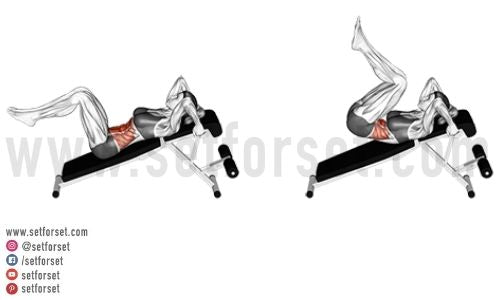
How To:
- Lie down on decline bench with your head towards the top then reach behind you to the sides and grab the bench so that your elbows are pointing towards the ceiling
- Keeping your legs together, bend your knees at 90 degrees
- Crunch your knees up towards your head while keeping your upper back in contact with the bench
- Slowly lower to starting position
- Repeat for desired reps
Note: Don’t use momentum to swing your legs up. Move with purpose in a slow and controlled manner.
7. Decline Sit Up
The decline sit up is the next step up in difficulty from a regular sit up because you move through a wider range of motion and work against gravity. Keeping the arms straight up adds an extra challenge.
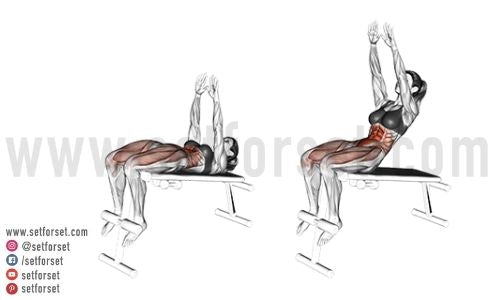
How To:
- Set up the bench on a 30-45 degree decline
- Get into position on the bench with your knees bent and feet locked in
- Raise your arms straight up towards the ceiling
- Lift your torso up towards your feet while keeping your back straight until you’re sitting upright
- Slowly lower down to starting position
- Repeat for desired reps
Note: Don’t round the back like you would with a crunch, this motion requires you to keep your back straight.
8. Decline Twisting Sit Up
This version adds trunk rotation, which hits the obliques and deep core muscles. Many people undertrain rotation patterns, so this is a great addition.
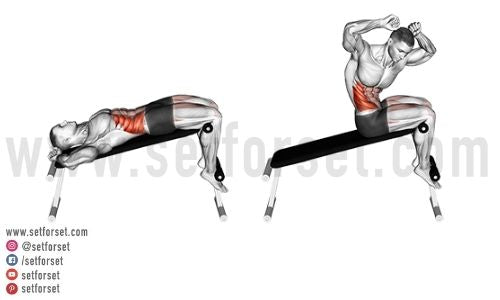
- Set up the bench on a 30-45 degree decline
- Get into position on the bench with your knees bent and feet locked in
- Clasp your hands behind your head
- Lift your torso up towards your feet while rotating at the trunk and crunching down with your albow poiting across your body
- Slowly lower down to starting position
- Repeat for desired reps alternating the rotation to each side
Note: Make sure to stress the cross body rotating movement to activate your obliques.
Here is an easier modification of the previous exercise because you're on the floor resulting in a lower range of motion.
Twist Sit Up

How To:
- Lie on the floor with calves on the bench
- Place hands lightly behind your head
- Crunch up and rotate so one elbow moves toward the opposite knee
- Lower with control and repeat on the other side
9. Reverse Crunch on Flat Bench
The reverse crunch on a bench is a great exercise to work the abs without putting much tension on your neck. It hits the rectus abdominis, transverse abdominis and obliques.
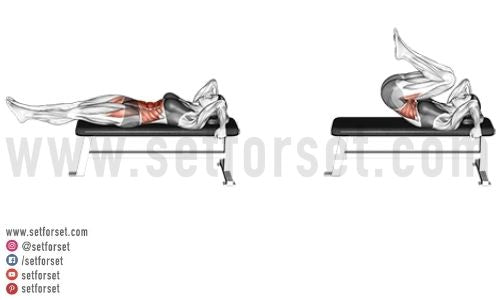
How To:
- Lie down on your back on a bench with your arms next to your sides and legs straight in front of you hanging off of the bench
- Pull your legs in and contract your abs while tucking your knees up towards your chest as you exhale until your butt is lifted off the bench
- Slowly return to starting position by reversing this motion
- Repeat for desired reps
Note: Pay attention to contract your abs at the top of the movement.
Below is the harder variation of the reverse crunch because you're fighting against gravity and adding a larger range of motion.
Decline Reverse Crunch
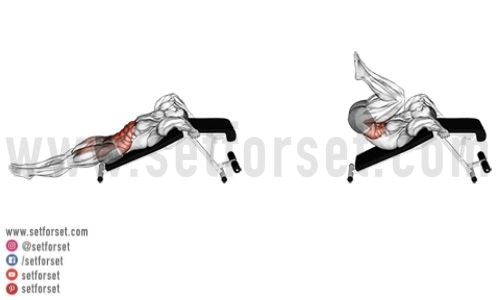
How To:
- Set a bench to a decline and lie back with your head higher than your hips
- Grab the bench behind your head for support
- Bring knees toward your chest, then curl your pelvis up slightly
- Lower slowly until legs are extended again without losing control
10. Incline Leg Hip Raise
Blast the rectus abdominis with this exercise. Besides working the core muscles, your hips and leg muscles are also activated. If you really want a challenge, lower your legs from top to bottom over a slow count.

How To:
- Lie down on a decline bench with your head towards, legs straightened out below you then top then grab both sides of the bench
- Slightly bend knees and lift legs so that your feet are pointing towards the ceiling
- Lift your butt off the bench while exhaling and push feet upwards so that your feet are above your head
- Slowly return to starting position
- Repeat for desired reps
Note: Move in a slow and controlled manner as you raise your legs and lower them.
11. Leg Bench Side Bridge
This side bridge with your feet elevated on a bench will light up the obliques and spinal stabilizers so your hips don’t drop. It also trains the quadratus lumborum and hip abductors.
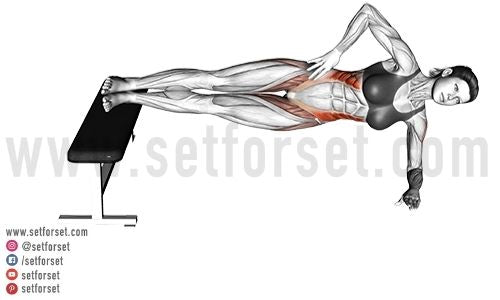
How To:
- Lie down on your side perpendicular to the bench
- Bring your legs up on the bench so that your lower leg’s ankle is in contact with the bench
- Brace yourself with your elbow and forearm on the ground directly under your shoulder with your hand pointing away from you.
- Keep your body in a straight line and hold this position for desired time
- Repeat for desired reps on both sides equally
Note: To make this easier, move closer to the bench so more of your legs are supported.
12. Elevated Side Plank
This plank variation is a killer oblique exercise. It is also great for shoulder and hip stability and does not put much pressure on the lower back when done correctly.
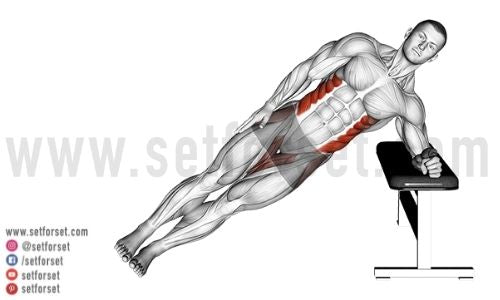
How To:
- Stand to the side of a bench then place your closest arm’s elbow on the bench so that it’s under your shoulder
- Extend your legs so that your body is in a straight line, keep your core engaged and your hips up the whole time
- Hold this position for desired time
- Repeat desired number of reps
- Switch sides
Note: Don’t let your hip sag. The higher the bench, the harder it is. Build up from a standard side plank first.
13. Elevated Leg Plank
The elevated leg plank strengthens the abs, shoulders and back muscles. The erector spinae, transverse abdominis and rectus abdominis all work to maintain the hold.
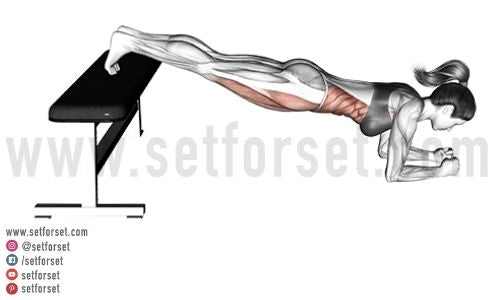
How To:
- Get into plank position perpendicular to the bench with your elbows on the ground under your shoulders
- Lift your legs up behind you and place your toes on the bench
- Hold this position for desired time
- Repeat for desired reps
Note: Don't let your hips sag. Keep a straight line from shoulders to heels.
14. Half Hollow Body Hold
The hollow body hold is a classic isometric core move. This half version reduces difficulty by keeping arms down rather than overhead.
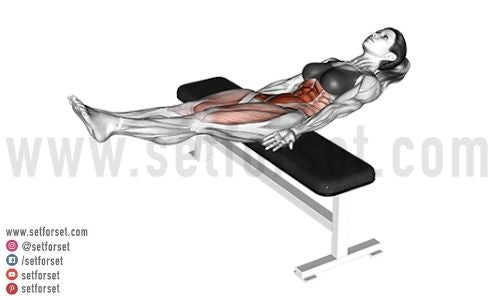
How To:
- Sit perpendicular to the bench
- Bring your legs up and together out in front of you then lean back so that your body forms a banana shape with your hands to your sides
- Hold this position for desired time
- Repeat desired reps
Note: Don’t cheat by using your hands to support the position.
15. Self Assisted Inverted Pullover
This exercise works the arms, chest, back, core, and legs. It is a great full-body core finisher.
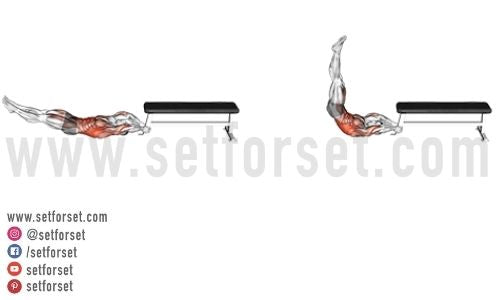
How To:
- Lie down on your back in front of a bench
- Reach up behind your head to grab the leg of the bench then raise your legs 6 inches off the floor
- Lift your legs up off the floor while contracting your hip flexors and core muscles until your legs are pointing up towards the ceiling
- Slowly lower to starting position
- Repeat for desired reps
Note: Squeeze the upper body muscles to help create a stable movement.
16. Knee Tuck Ups
This is also called the in and out exercise. It is great for core strength and a little conditioning. Want a harder version? Try it without holding the bench.
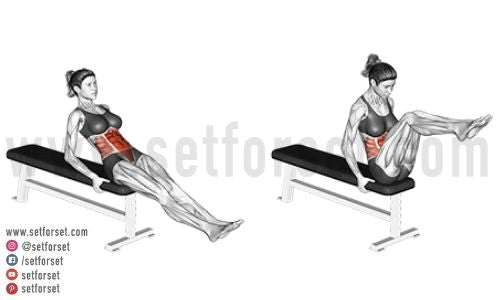
How To:
- Sit on the edge of a bench while grabbig the edges next to your hips
- Lean back and lift your feet off the floor. At this point your body will be in a straight line, this is the starting position.
- Bend and lift your knees towards your chest as you sit up until your knees are close to your chest
- Slowly return to starting position
- Repeat for desired reps
Note: Keep your core engaged and focus on contracting your abs to reduce tension on the hip flexors.
17. Bench Reverse Crunch Circle
This takes body control and strength. Compared to leg circles on the floor, the bench version is harder because your torso angle increases the demand on your abs.
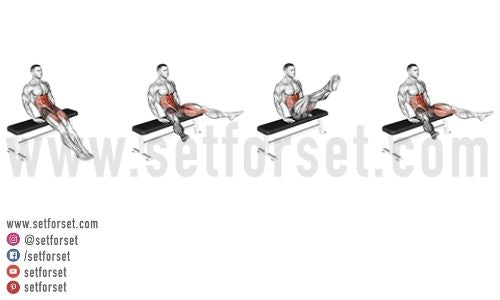
How To:
- Sit on a flat bench in the middle so that your body is perpendicular to it
- Sit with your back straight then lean back slightly while gripping the edge of the bench with both hands to your sides then bring your legs together out in front of you
- Lift your legs up and to the side while keeping your upper body stationary. Move your legs in a circular motion so that at the top of the movement you’re in V position with your feet at head level then continue the circular motion until you end up at the starting position
- Repeat desired reps with an equal number of complete circles done in both directions
Note: Keep your legs straight and together. For an easier modification, bend knees to 90 degrees.
18. Seated Flutter Kick
Flutter kicks on the bench target the lower abs while also hitting glutes, hip flexors, and quads. This version is harder than on the floor because your upper body angle keeps tension on the abs.
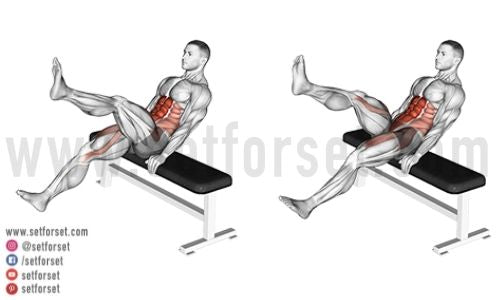
How To:
- Sit perpendicular on the bench the grab the edge of the bench next to your hips
- Lean back then bring your feet off the floor
- Lift one leg at a time to head level then lower it to starting positions as you lift your other leg
- Alternate legs lifted in a controlled manner
- Repeat for desired reps
Note: Keep your upper body stationary and avoid swinging with momentum.
19. Seated Alternate Crunch
This one combines upper body movement with leg drive, keeping constant tension on the core while also working hip flexors and thighs.
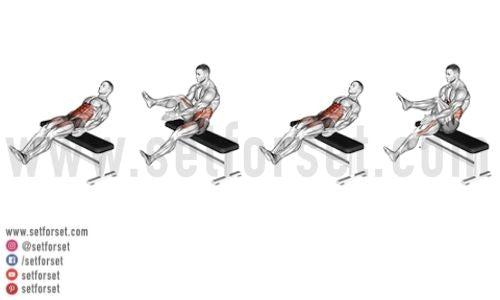
How To:
- Sit perpendicular on the bench then lean back and bring your feet off the ground. This is your starting point where your core should already be engaged.
- Simultaneously lift one leg up while moving your chest towards that leg. Once your knee is at chest level you can ad a clap between your legs to help keep the rhythm.
- Slowly lower your leg and upper body to starting position then repeat with the other leg
- Alternate back and forth for desired number of reps
Note: You can keep a slight bend at the knees throughout the movement.
20. Lying Leg Raise w/ Hip Thrust on Flat Bench
The lying leg raise works abs, hip flexors, quads, and lower back. Keep reps controlled and avoid swinging.
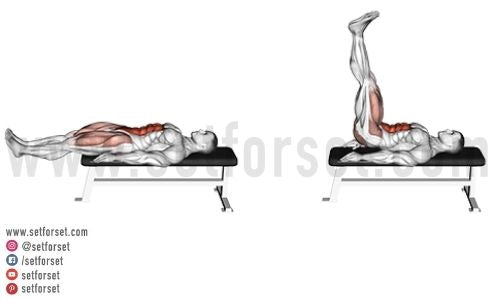
How To:
- Lie down on your back on the bench with your legs hanging off the edge. Place your arms to your sides with your palms down to help with stability
- Lift your legs towards the ceiling while keeping your back against the bench
- At the to of the movement slightly raise your glutes off the bench
- Slowly return to starting position
- Repeat for desired reps
Note: The extra contraction at the top is where you'll feel the most ab work.
21. Weighted V Sit Up
This will challenge your core, glutes, hip flexors, and thighs. Start light, prioritize control, and progress gradually.
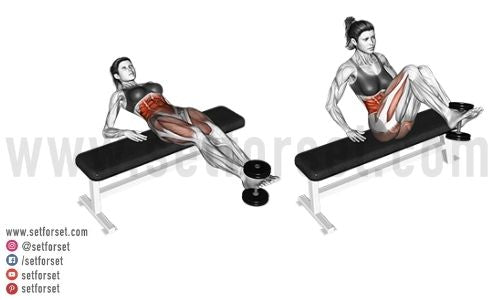
How To:
- Sit perpendicular on a bench and place a dumbbell between your feet then place your hands to your sides on the bench to help with stability
- Lean back and lift your legs out in front of you holding the weight, this is the starting position with your body in a straight line
- Crunch up while exhaling, bringing your knees and chest towards each other
- Once your knees reach chest level, slowly return to starting position
- Repeat for desired reps
Note: Start with a light weight you can control for 10 clean reps before increasing load.
Related:
- 30 Best Bodyweight Core Exercises From Beginner to Advanced
- Sit Ups vs Crunches, Which is Better?
- Planks vs Crunches, Which is Better?
How to program bench ab exercises into your workout program
- Include a variety of movements that touch on rotation, lateral flexion and spinal flexion
- Choose 3-5 exercises to focus on
- Add resistance if you want to build thicker abs with the like of dumbbells, bands, kettlebells and machines
- Switch up your ab routine every 3-4 weeks
- Use a variety of exercises, reps/sets, sequence, resistance, tempo, type of contraction, body positioning
Simple progression ideas: add 1-2 reps per set, slow the lowering phase to 3-5 seconds, increase decline angle slightly, or add load to 1-2 movements per session.
Ab bench workout
In this ab bench workout you'll hit the major abdominal muscles plus lower back, glutes, hip flexors and some leg muscles.
The key to getting the most from bench ab exercises is control. Move slowly, own the range of motion, and focus on contracting the abs rather than swinging the legs.
Run this circuit 3 times with as little rest as needed between exercises. Take 1-2 minutes of rest between rounds.
- Decline Crunch: 3 sets x 15 reps
- Elevated Side Plank: 3 sets x As long as possible
- Incline Hip Raise: 3 sets x 10 reps
- Leg Circles: 3 sets x 5 reps (circles in each direction)
- Half Hollow Body Hold: 3 sets x As long as possible
Will ab exercises help me lose stomach fat?
No, ab exercises alone won’t reduce stomach fat (spot reduction is not how fat loss works). This study found no significant fat loss from ab exercises alone.
To reduce stomach fat, you need a combination of nutrition, full-body training, and overall energy balance. Whether you’re skinny fat or you are starting a cutting program, ab training is a helpful component, but it is not the whole solution.
Is it possible to work the upper and lower abs separately?
You cannot fully isolate “upper” vs “lower” abs because the rectus abdominis is one muscle, but you can emphasize regions by changing the movement. Trunk-focused flexion patterns (crunches) tend to feel more “upper,” while pelvis-driven patterns (reverse crunches) tend to feel more “lower.”
For example, stabilizing the hips and lifting the trunk will emphasize the upper ab region more. Reverse crunch variations, where your pelvis lifts, tend to hit the lower abs feeling more.

Frequently Asked Questions
How many bench ab exercises should I do in one session?
Most lifters do best with 3 to 5 exercises per session. Pick one flexion movement, one reverse crunch or hip raise variation, one plank variation, and one oblique-focused movement.
What if bench ab work hurts my lower back?
Back discomfort often comes from using too much hip flexor or excessive arching. Reduce range of motion, slow down, and focus on ribs down and pelvis control. If pain persists or is sharp, stop and consult a qualified healthcare professional.
Do I need weights for abs?
You do not need weights to build a strong core, but load helps if you want thicker abs and strength progression. Start with bodyweight, then add resistance once you can control the movement through full range of motion.
Final Note
Training your abs makes you stronger, more stable, and more resilient. The bench is a simple way to add variety and progression without overcomplicating your program. Next time you are in the gym, pick 3-4 of these and run a quick bench core circuit between sets.
Looking for more great core exercises? Check out these 12 Best Standing Ab Exercises, Rotational & Anti-Rotational Core Exercises, and the best Resistance Band Ab Exercises!
2 comments
Great read, I love how you broke down the progression from beginner to advanced ab work with the bench and highlighted the importance of core strength in everything from posture to lifts. When I incorporate this routine into my training I’ll also rotate in some cable pulley gym to keep my routine fresh and engage the core differently. Really appreciate the detailed explanations of each variation. Thanks for sharing!
Very helpful. Just got an incline bench, using primarily for core work. Lost tone/flexibility during last 2 years .working on regaining prior to return to karate.