


If you want broad, muscular, well-defined pecs, dumbbell chest exercises are a must. I have nothing against the barbell bench press, it absolutely works, but dumbbells give you more freedom, more range, and more ways to actually sculpt your chest instead of just moving weight from A to B.
In this guide, you’ll get the “why” behind dumbbell chest training, a quick chest anatomy refresher, and then 3 dumbbell-only chest workouts you can plug into your split.
Take Your Fitness To The Next Level


| Quick Answer: Dumbbells are one of the best tools for building your chest because they allow a bigger range of motion and demand more stability. Use presses as your foundation, add fly variations for stretch and squeeze, and progress week to week with reps or load. |
| Key Takeaways | Do this |
|---|---|
| Press first | Start with a flat or incline dumbbell press and push progressive overload. |
| Chase quality reps | Use a full range you can control and own the stretch. |
| Use flys to “finish” | Add 1-2 fly variations for tension and a hard contraction. |
| Train chest 1-3x/week | More frequency is fine if you recover well and keep volume sane. |
| Protect your shoulders | Keep your shoulder blades controlled and avoid forcing painful depth. |
Table of Contents:
- Chest Anatomy & Functions
- 15 Best Dumbbell Chest Exercises
- 3 Chest Workouts Using Only Dumbbells
- Benefits of DB Chest Exercises
- FAQs
- Final Takeaways

Prepare to maximize your gains with our exclusive 12-week hypertrophy training program. Choose between a 4 or 5 day training split and gain 2-12 pounds of muscle over 90 days...
CHEST ANATOMY & FUNCTION
Quick anatomy helps you train smarter. Different angles and arm paths shift emphasis across your pec fibers, which is why dumbbells are so effective.
Your chest is mainly made up of the pectoralis major and pectoralis minor.
Pectoralis major: This is the big fan-shaped muscle you see in the mirror. It’s commonly described as having an upper (clavicular) portion and a middle/lower (sternocostal) portion. In real life, it all blends together, but the takeaway is simple. Pressing and hugging motions train the pec major, and incline angles tend to bias the upper fibers.
Main actions: shoulder horizontal adduction (bringing your arms across your body), shoulder flexion (lifting your arm forward and up), and internal rotation. That’s why presses and flys cover so much territory.
Pectoralis minor: A smaller muscle under the pec major that helps control your shoulder blade. You’re not trying to “grow” pec minor like a bodybuilder grows pec major. You’re trying to keep it strong and functional so your shoulders stay happy when you press a lot.
Serratus anterior: Not technically a chest muscle, but it matters. It helps move your shoulder blades forward and upward. Dumbbells and push-up variations can light it up because your shoulder blades are allowed to move more naturally.
Note: Your triceps and front delts are working as secondary muscles in pretty much every pressing variation below.
15 Best Dumbbell Chest Exercises
You've arrived at our list of best dumbbell chest exercises! We're going to list the top 15 and following the list will discuss each individually.
The 15 best dumbbell chest exercises are:
- Dumbbell Flat Bench Press
- Deep Push Up
- Dumbbell Twisted Fly
- Dumbbell One Arm Chest Press
- Dumbbell Incline Around The World
- Dumbbell Incline Fly
- Dumbbell Pullover
- Hyght Dumbbell Fly
- Dumbbell Standing Low Fly
- Dumbbell Reverse Bench Press
- Dumbbell Lying Hammer Press
- Dumbbell Svend Press
- Dumbbell Squeeze Press
- Dumbbell Decline Bench Press
- Dumbbell Decline Chest Fly
These moves will help you build strength, power, and a well-defined chest. Let's dive in and transform your upper body with these effective DB chest exercises!
Ready to get right to the workouts? Scroll down past the exercises.
1. Dumbbell Flat Bench Press:

The dumbbell chest press should be a staple in everyone’s chest day workout plan. It is an effective, all-around compound dumbbell exercise that activates the entire chest (with emphasis on the sternocostal head), and it allows for the heaviest load and greatest range of motion, all of which are great for building up impressive pecs of steel.
Be sure to keep the movement balanced by moving your arms with equal space and speed. Use a weight that you can control well so you can get a deep stretch and full contraction at the top.
2. Deep Push Up:

The deep push up takes a regular push up to the next level by allowing for a greater range of motion on the eccentric phase. Essentially, you can go deep, maximizing the stretching tension in your chest.
The nice thing about this move is that if you alter your foot/body/hand positioning, you can change how the push up hits your pecs. For example, if you put your feet up on a platform, you can target your upper chest more. If you bring your hands closer together, you can target the inner chest more.
If you experience pain when going deep into the push up, limit your range of motion. Over time you can work on increasing your range of motion by getting lower and lower.
3. Dumbbell Twisted Fly:

The dumbbell fly is a classic accessory exercise for opening up the entire chest, improving range of motion, and building solid definition of your inner chest. The dumbbell twisted fly is the same exact concept but it allows for even more muscle fiber activation.
By rotating your arms slightly so that as you reach the top, your palms are in an underhand grip, you will get a stronger contraction. As you lower back down, you rotate your hands back so that they are facing each other like a traditional dumbbell fly during the stretching phase.
This exercise will be a little more difficult than the traditional dumbbell fly. Be sure to use an appropriate weight and keep your elbows fixed throughout and don’t overextend at the shoulder joint.
Note: This exercise can be done from an incline and decline position as well. The incline will hit the upper-inner chest more and the decline for the lower-inner chest.
4. Dumbbell One Arm Chest Press:

The one arm chest press is the same as the flat bench press but you will only be using one dumbbell and targeting one side at a time. By doing this, you are forcing yourself to use more core and hip stability, which is great for core strength.
Also, you can use an even greater range of motion on the concentric phase, and you can further improve muscle imbalances and movement patterning.
When doing one arm dumbbell presses, focus on keeping your core and hips down and squared straight up. Get a good stretch each rep and fully contract at the top (even slightly exaggerating the range of motion by moving the dumbbell up higher and toward your centerline).
5. Dumbbell Incline Around the World:

The dumbbell around the world is not a well-known exercise, but it doesn’t mean it’s not effective. This exercise is great for the chest and shoulders, but you should have healthy shoulders to perform it as it moves your shoulder blades through a large range of motion.
To start, sit on the incline bench and hold the dumbbells at your sides near your thighs with your palms up and elbows slightly bent. From there, rotate your arms up. When the dumbbells are overhead and nearly touching, squeeze your chest and return them to the starting position through that same path of motion, then repeat.
This exercise can be done using a flat bench too. The incline emphasizes your upper chest.
6. Dumbbell Incline Fly:

The dumbbell incline fly is great for building the upper-inner area of your chest. Focus on squeezing your chest to raise the dumbbell rather than using just your arms. Get a deep stretch if your shoulder mobility allows for it, but there’s no need to go down too low to where the stress starts to be placed on your shoulders rather than your chest muscles.
If you can't get a good stretch in your chest due to shoulder mobility, work on improving your mobility as this exercise is best when you can get a full pectoral stretch on the eccentric phase.
Note: You can add a twist at the top by rotating your arms so your palms face up for even more contraction.
7. Dumbbell Pullover:

The dumbbell pullover is a hypertrophy accessory exercise that became popular in the Arnold era. It works your arms, back, and chest at the same time, more specifically your upper chest and lats.
The variation of placing just your upper back on the bench adds an element of core strength to the exercise.
It is also a good exercise for posture and improving mind-muscle connection. To make this exercise effective for your upper chest, you need to really focus on that area. As the dumbbell comes up past your head, you will need to squeeze the heck out of your upper chest. Keep a slight bend in your elbows at all times.
Note: Another variation involves using two light weight dumbbells held side-by-side with palms facing up. This will put a little more tension on the outer part of your chest, whereas the single dumbbell pullover puts more emphasis on your upper-middle chest as your hands are closer together.
8. Hyght Dumbbell Fly:
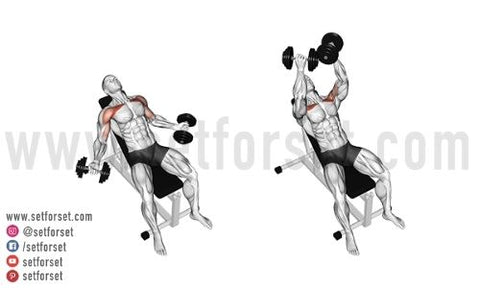
This is another good dumbbell accessory exercise for chest hypertrophy. However, you will need good motor control to perform it correctly and effectively. It is very similar to a standing low to high cable fly, but you will be sitting on a bench in an incline position.
To do this exercise, put the bench at about 45˚ (which is slightly higher than normal for incline flys/presses). Hold the dumbbells at your sides with an underhand grip and a slight bend in your elbow. Your arms should be at about a 45˚ angle away from your body.
Contract your chest and raise the dumbbells up, keeping your elbows and wrists fixed. Stop when the bells of both dumbbells are just about to touch each other, then return slowly back to the starting position through the same path of motion.
9. Dumbbell Standing Low Fly:

The dumbbell standing low fly allows you to target your upper and inner chest. It is just like a cable pulley low to high fly. The dumbbells will be held with an underhand grip.
Your elbows should be slightly bent and about 30˚ away from your body. Raise your arms up to your centerline at about chin level. Squeeze your chest, slowly lower back down, and repeat.
10. Dumbbell Reverse Bench Press:
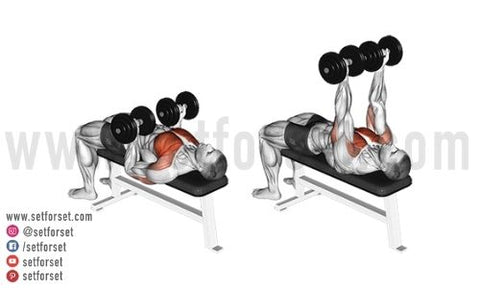
The dumbbell reverse bench press is like a regular bench press except you are holding the dumbbells in reverse (underhand grip) and your arm positioning is a little closer to the body.
By simply changing your grip, you are placing more emphasis on your upper chest and you are taking pressure and tension off your shoulders. It also hits the triceps to a greater degree than the standard bench press.
A lot of trainers use this exercise for people who have shoulder issues and bodybuilders use it because it is very effective at hitting the upper chest and triceps without the shoulders doing too much work.
11. Dumbbell Lying Hammer Press:

The hammer press is a good alternative to the standard dumbbell bench press for those who want to take a little stress off their shoulders.
Like the standard bench press, the exercise emphasizes the sternocostal head, but as you hold the dumbbells in a hammer grip (neutral position), you can get them a little closer together at the top, which allows for an even greater contraction of the inner chest.
12. Dumbbell Svend Press:
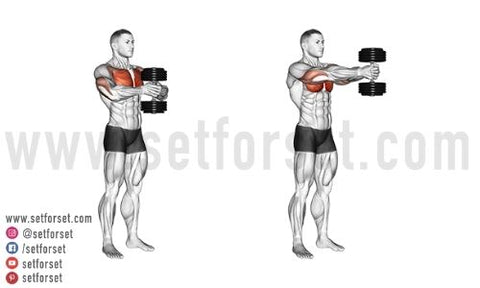
If you’ve been in the gym for some time, you’ve probably seen this exercise being done with a weight plate. The Svend press is a standing chest exercise where you press the weight straight forward with your hands in a prayer-like position.
When using a dumbbell, you simply hold it in vertically with both hands on the handle. Your arms will be at about sternum level and from there you slowly press forward until your arms are extended then slowly bring it back to your chest.
Note: You can also hold it by the top of the bell if you are using a light hex dumbbell.
The exercise is simple but it will require some good mind-muscle connection to feel it in your chest rather than just your shoulders. Try to keep your shoulders down by keeping your scapula down and in (downward rotation). If done correctly, you should feel it in your pecs nicely. Your lower-inner chest and upper chest will get good activation.
13. Dumbbell Squeeze Press (aka Crush Press):

This is a variation of the bench press where you hold the dumbbells pressed together with a neutral grip (palms facing each other). The dumbbells will be kept in contact with each other at all times during the exercise, so you will be squeezing them together as you press up and down in a straight path at your chest’s centerline.
This exercise is great for full chest activation, but the primary target is your outer, inner, and upper chest.
Be sure to really squeeze those dumbbells together as this is what makes the squeeze press so effective.
14. Dumbbell Decline Bench Press:

The dumbbell decline bench press targets the lower part of your pec major sternocostal head. If you want to develop a strong distinction between your chest and abs, this is a great one.
Don’t use too extreme of a decline. A 30% decline is fine. When you press up, keep the dumbbells in a path at sternum level or just slightly below your chest.
15. Dumbbell Decline Chest Fly:

The last on our best dumbbell chest exercise list is the decline fly. This exercise is done just like other flys but from a decline position. Like the decline bench press, only use a 30% decline and keep the fly motion at about sternum level.
Really squeeze the heck of your chest with this one. It’s going to smash your inner-lower chest well if done correctly.
As with all flys, keep your arms locked into position with a slight bend and squeeze your pecs to move the dumbbell up rather than just your arms and lower down slowly to really feel the stretch.
Prepare to maximize your gains with our exclusive 12-week hypertrophy training program. Choose between a 4 or 5 day training split and gain 2-12 pounds of muscle over 90 days...
DUMBBELL CHEST WORKOUTS
You are obviously not going to do all 15 dumbbell chest exercises in one workout. Instead, you want a simple plan: 1-2 presses, 1-2 fly variations, then one “finisher” that pumps the chest without wrecking your joints.
Programming tip: Keep at least one main press consistent for 6-10 weeks. Try to add a rep or a little weight over time. Rotate accessories more often if you want variety.
Start every workout with a 5-10 minute dynamic warm up to get your shoulders, elbows, and upper back ready to press.
DUMBBELL CHEST WORKOUT #1 (CHEST ONLY):
If you run a body part split and have a dedicated chest day, this is a solid template.
- Dumbbell Bench Press: 3 sets x 6-12 reps
- Dumbbell Incline Press: 3 sets x 10-15 reps
- Hyght Dumbbell Fly: 3 sets x 8-12 reps
- Dumbbell Pullover: 3 sets x 8-12 reps
- Dumbbell Deep Push Up: 2 sets x 10-20 reps
- Decline Dumbbell Fly: 2 sets x 10-15 reps
Rest guide: 90-150 seconds on presses, 60-90 seconds on flys and push-ups.
Note: Your main compound lifts should stay in your program week to week. Use progressive overload by adding reps, adding a small amount of load, or improving form and range. Accessories are where you can switch things up to hit fibers from new angles and keep training fun.
DUMBBELL WORKOUT #2 (CHEST & SHOULDERS):
This fits well in a push day for a push/pull/legs split.
- Dumbbell Bench Press: 3 sets x 6-12 reps
- Dumbbell Incline Fly: 3 sets x 8-12 reps
- Dumbbell Standing Shoulder Press: 3 sets x 6-12 reps
- Dumbbell Reverse Bench Press: 3 sets x 8-12 reps
- Dumbbell Lateral Raise: 3 sets x 10-15 reps
- Dumbbell Crush Press: 3 sets x 8-12 reps
DUMBBELL WORKOUT #3 (CHEST AND BACK)
Chest and back pair perfectly because they are opposing muscle groups. Supersetting pushes with pulls keeps things efficient, balanced, and intense without turning your session into a two-hour saga.
- Superset #1: Dumbbell Bench Press x Dumbbell Bent Over Row: 3 sets x 8-12 reps
- Superset #2: Dumbbell Fly x Dumbbell Reverse Fly: 3 sets x 10-12 reps
- Superset #3: Parallel Dips x Pull Ups: 3 sets x 6-12 reps
- Final Exercise: Dumbbell Pullovers: 3 sets x 8-15 reps

BENEFITS OF DB CHEST EXERCISES
Barbells are great for strength and overload, but dumbbells bring flexibility that most lifters are missing. If your goal is a bigger chest plus healthier shoulders, dumbbells belong in your weekly rotation.
The 4 big benefits of dumbbell chest exercises include:
- Greater range of motion
- More balanced strength and size
- More joint-friendly pressing paths
- More stabilizer and control demands
1. Dumbbells allow for a greater range of motion:
With a barbell, the bar touches your chest before your pecs hit their deepest stretch. Dumbbells let your elbows travel a bit lower (if your shoulders tolerate it), which increases the stretch on the pecs. A larger range of motion is associated with better hypertrophy outcomes when training is otherwise solid (hypertrophy)1.
Shoulder-friendly rule: Only go as deep as you can control without pain or shoulder “dumping” forward.
2. Balanced growth & strength:
With barbells, your stronger side can quietly do more work. Dumbbells do not let you hide. Each side has to produce force on its own, which helps clean up strength imbalances and keeps your reps honest.
If your left side is the “weak link,” you will feel it immediately. That’s a feature, not a bug.
3. Easier on the joints:
Dumbbells allow your wrists and elbows to find a more natural path. Neutral-grip presses and slight angle adjustments often feel better on shoulders than locked-in bar paths.
4. Strengthens stabilizer muscles better:
Because each hand controls its own weight, your body has to stabilize harder. That means more demand on rotator cuff muscles, pec minor, serratus anterior, and the upper back muscles that keep your shoulders in a strong position.
Research suggests dumbbell pressing can drive high pec activation compared to more fixed modalities due to both range of motion and stability demands2.
Dumbbell vs Barbell Comparison for Chest Exercises:
|
Factor |
Dumbbell Chest Exercises |
Barbell Chest Exercises |
|
Stability |
Higher demand, more control work |
More stable, easier to overload |
|
Range of Motion |
Often greater ROM and stretch potential |
ROM limited by the bar touching the chest |
|
Imbalances |
Reveals and helps fix left-right differences |
Stronger side can compensate more easily |
|
Joint Comfort |
More freedom to find a comfortable path |
Fixed grip and bar path for everyone |
|
Loading |
Great for hypertrophy and control |
Best tool for maximal strength work |
FAQs ABOUT CHEST EXERCISES WITH DUMBBELLS:
Here are some common questions people ask about training chest with dumbbells.
Are dumbbells better for chest development?
Dumbbells are excellent for building a strong, muscular, well-developed chest and improving control and symmetry. They also make it easier to adjust angles and grips, which can be helpful if certain pressing patterns irritate your shoulders.
Why do I feel it in my arms and not my chest when doing chest exercises?
If you feel chest work mostly in your arms, it usually comes down to technique, load, or setup. Fix these first:
- Too much weight: Go lighter and control the eccentric. If your triceps take over, your chest never gets a fair shot.
- Press path and elbow angle: Keep elbows slightly tucked (not flared straight out, not pinned to your ribs).
- Shoulder position: Keep your upper back tight on presses so your chest has a stable base to push from.
- Mind-muscle connection: Slow down, pause briefly in the stretched position, and squeeze at the top.
If you want a simple cue: think “bring my biceps toward each other” instead of “push the dumbbells away.”
How heavy should my dumbbells be for chest exercises?
Choose a load that lets you keep clean form and hit the target rep range while staying 0-2 reps shy of failure on most sets. If the last reps turn into a shoulder shrug and a prayer, it is too heavy.
Can dumbbell chest exercises help correct muscle imbalances?
Yes. Dumbbells force each side to work independently, which is one of the best ways to address left-right strength differences.
How often should I perform a dumbbell chest workout?
Most lifters do well training chest 1-3 times per week depending on volume and recovery. If you are chasing growth, 2 times per week is a strong sweet spot for many people.
Can I build a well-defined chest using only dumbbells?
Absolutely. With presses, flys, and pullovers (plus push-ups if you want), you can cover all the key chest functions and build serious size and definition.
How do you best build your chest with dumbbells?
Keep it simple and consistent:
- Use multiple angles over the week (flat plus incline is plenty for most people).
- Progressively overload by adding reps, load, or better control over time.
- Eat and sleep like it matters, because it does.
- Train your back and shoulders too. A bigger chest looks better when the rest of your upper body keeps up.
What is the best rep scheme and volume for dumbbell chest workouts?
Use a mix of rep ranges so you build strength and size together. Presses can live in moderate reps most of the time, and flys can live a little higher.
Main Compound Exercises:
- 3-6 reps using 85-90% 1RM
- 6-12 reps using 70-80% 1RM
- 12-20 reps using 60% 1RM
Isolation/Accessory Exercises:
- 6-12 reps to near failure
- 12-20 reps to near failure
How to Target the Upper Chest with Dumbbells?
The upper chest (clavicular head) contributes more when you press at an upward angle or bring the arm up and forward. That’s why incline dumbbell presses, incline flys, and low-to-high fly patterns tend to hit it best.
If your upper chest lags, give it first priority in the workout when you are freshest.
How to Target the Lower Chest with Dumbbells?
The sternocostal portion contributes heavily on flat and decline pressing patterns. You can’t fully isolate it, but you can bias it with flat presses, slight decline presses, and parallel dips.
How to Target Middle/Inner Chest with Dumbbells?
“Inner chest” is not a separate muscle, but the idea people are chasing is real. You create more tension near the midline when you bring your hands toward each other and squeeze hard at the top.
Flys, squeeze presses, and close-path pressing variations are your best bets for that strong contraction and visible separation.
For more, see inner chest exercises.
How to target the pec minor?
Pec minor is mostly a stability muscle for the shoulder blade. It works during presses and dips, and it gets more involved when you lean forward and control your shoulder blades well.
How to target the serratus anterior?
You will feel the serratus more when your shoulder blades are allowed to protract. Dumbbell push-ups, one-arm presses, and movements that finish with a controlled “reach” can help. For more options, check serratus anterior exercises.
Can I do dumbbell chest exercises without a bench?
Yes. Floor presses and flys work well (with a shorter range on the way down). A stability ball can also mimic a bench and adds core stability. Deep push-ups are another great choice because you can adjust body angle to bias different areas of the chest.
Check out this article to see the 13 Best Dumbbell Chest Exercises WITHOUT a Bench.
Final Takeaways
Depending on your split, hitting chest 1-3 times per week can work. Pick a couple dumbbell presses you can progress, add fly variations for stretch and squeeze, and stay consistent. Do that for long enough, and your chest has no choice but to level up.
Prepare to maximize your gains with our exclusive 12-week hypertrophy training program. Choose between a 4 or 5 day training split and gain 2-12 pounds of muscle over 90 days...
References:
- McMahon GE, Morse CI, Burden A, Winwood K, Onambélé GL. Impact of Range of Motion During Ecologically Valid Resistance Training Protocols on Muscle Size, Subcutaneous Fat, and Strength. Journal of Strength and Conditioning Research. 2014. doi:https://doi.org/10.1519/jsc.0b013e318297143a
-
Farias D de A, Willardson JM, Paz GA, Bezerra E de S, Miranda H. Maximal Strength Performance and Muscle Activation for the Bench Press and Triceps Extension Exercises Adopting Dumbbell, Barbell, and Machine Modalities Over Multiple Sets. Journal of Strength and Conditioning Research. 2017. doi:https://doi.org/10.1519/jsc.0000000000001651
0 comments