


A proper warm-up should do more than make you feel loose. It should raise your body temperature, prepare the joints and muscles you are about to use, rehearse the movement patterns in your workout, and help you perform with better speed, strength, and control.
This guide covers 10 of the best dynamic warm-up exercises for a full-body workout. You will also find a complete 10-minute follow-along routine that can be used before strength training, conditioning, sports, or an at-home workout.
What Is The Best Dynamic Warm-Up?
The best dynamic warm-up combines light whole-body movement, active mobility, muscle activation, and exercise-specific practice. For most people, 5-10 minutes is enough.
A simple warm-up should:
- Gradually raise your heart rate and body temperature
- Move the joints you will use through a comfortable range of motion
- Activate the muscles needed for the workout
- Include movements that resemble the exercises or sport that follows
- Finish with one or more lighter practice sets before heavy or explosive work
Dynamic stretching generally works better before strength, speed, and power training than long, passive static stretches. However, brief static stretching is not automatically harmful, especially when it is followed by dynamic and activity-specific movement.
Dynamic Warm-Up At A Glance
| Warm-Up Goal | What To Include |
| Raise Body Temperature | Brisk walking, jogging, jumping jacks, rowing, or flowing bodyweight movements |
| Improve Mobility | Dynamic hip, ankle, shoulder, and thoracic-spine movements |
| Activate Muscles | Squats, glute bridges, scapular movements, planks, or lunges |
| Prepare For Lifting | Progressively heavier warm-up sets of the first exercise |
| Prepare For Sport | Drills that match the speed, direction, and movement patterns of the activity |

WHAT IS A DYNAMIC WARM UP?
A dynamic warm-up involves short dynamic stretches and movements aimed to loosen up your joints and the surrounding muscles and increase your body temperature and blood flow. The exercises in a dynamic warm-up should mimic movements that you will use in the workout to come, as to optimize your range of motion and prepare your muscles to endure resistance and tension. When doing a dynamic warm-up, you should emphasize the mobility and stability of joint complexes that will bear the brunt of your workout.
Should You Stretch Before Working Out?
You should do short dynamic stretches of 1-5 seconds before working out, but you should not do long holds. The goal is to loosen up and decrease stiffness, not create too much laxity.
Static Stretching vs Dynamic Stretching
Static stretching involves holding a position, usually for 15-60 seconds. Dynamic stretching moves a joint repeatedly through a controlled range of motion.
Long static holds immediately before maximal strength, sprinting, jumping, or other explosive activity may temporarily reduce force or power, particularly when the stretches are intense or prolonged. That does not mean static stretching is always bad before exercise. Short holds can be useful when a specific mobility restriction prevents good technique, especially when followed by dynamic movement and practice sets.
For most workouts, use dynamic mobility during the warm-up and save longer static stretches for a separate flexibility session or after training. The goal before exercise is readiness, not simply becoming as flexible as possible.

KEY FOCUS OF A WARM UP
The perfect warm up should focus on:
- Mobility
- Joint Stabilization
- Increasing body temperature
- Increasing blood flow to your joints and muscles
Mobility and joint stabilization come from dynamic stretches. This will improve and optimize your range of motion.
Increasing body temperature and blood flow comes from bodyweight movements that mimic the main exercises in your workout. By getting your blood flow up to par, you will have more strength.
Together, you will improve your durability. Durability is what you want as it will make you injury resilient and more powerful during your workout.
Durability = Mobility + Strength
BENEFITS OF A DYNAMIC WARM UP BEFORE WORKING OUT
A good warm up provides an array of benefits.
- Improves Performance: A warm up gradually revs up your cardiovascular system (i.e., heart rate), increasing muscle temperature and allowing more oxygen to be available for your muscles. This will help you perform the strenuous task to come with greater ease.
- May Help Reduce Injury Risk: A well-designed warm-up can improve movement readiness and has been associated with lower injury rates in some sports, especially when it includes strength, balance, agility, and sport-specific drills. No warm-up can eliminate injury risk.
- Improves Range of Motion: Dynamic warm ups put emphasis on mobility (not just cardio), so you will have the necessary range of motion to perform your exercises to the greatest effect. Moving through a full range of motion will allow you to reap the full benefits of any given resistance exercise.
- Prepares You Mentally: Not all of working out is physical. Your mind plays an important role. Most of the time, your mind gives up before your body. A warm up will gradually get your mind ready for a rigorous workout. Jumping straight into it without warming up can definitely throw off the mental side of your workout. So keep that in mind.
- Reduce Soreness & Tension: If you are sore from a previous workout, you should not work the muscles that are sore. However, even some soreness in areas you are not planning to train can affect your workout. A warm up will loosen you up and increase your blood flow, which will help reduce soreness and tension in your muscles. Thus, you can improve your all-around performance.
HOW TO EXECUTE A DYNAMIC WARM UP BEFORE A WORKOUT
When warming up, you need to focus on two things, mobility and getting your heart rate and body temperature up. To do that, you need to do dynamic stretches and bodyweight movements.
A good dynamic warm-up will be full-body, even if you don’t plan to do a full-body workout. That said, if you are working a specific muscle group (or upper body/lower body, push/pull, etc.), then you should emphasize movements and stretches around the joint complexes that will bear the brunt of your workout.
For example, if you plan to train your legs, you can do a full-body warm up that involves a couple upper body dynamic stretches and movements with 4-6 lower body dynamic stretches and movements. That way you are targeting your full-body, but you are putting greater focus on the area you plan to train. You may not think it is important to target your shoulder or thoracic spine on leg day, but it is. You need your full-body to train even specific muscle groups (i.e. you can't train your back without your shoulders and arms, and often hamstrings). This is especially true if you are doing proper, compound exercises, which we highly recommend over machines (at least for the majority of your workout).
Now, let’s go over a little more about how to do dynamic stretches and how to get your cardiovascular system in check.
There are two ways to go about a dynamic warm-up:
- You can incorporate bodyweight movements and dynamic stretches into one routine or sequence, similar to yoga. This way you fill both needs with one deed.
- You can first do some form of cardio (jog, skipping, jumping jacks, rowing, etc.), then do some dynamic stretches to improve your range of motion.
Both ways are fine, but to save time, we prefer option 1.

Dynamic Warm Up Sequence/Routine: We will be showing you a full length warm-up routine that includes 10 of our favorite dynamic warm-up exercises. It is a sequence that involves both dynamic stretches and bodyweight movements that will get your body temperature up and improve your range of motion all in one.
Before we get into that, we just want to go over a few more things…
Joint-Focused
When it comes to a dynamic warm-up, you should focus on ALL your joints, not just the main ones we often talk about.
So, this includes:
- Ankles
- Knees
- Hips
- Spine
- Scapular
- Shoulders
- Elbow
- Wrists
Our dynamic warm-up below targets all of the joints above.
PLUS…the following muscles…
A good dynamic warm-up, as ours is, will dynamically stretch the muscles of both your upper and lower body:
- Calves
- Hamstrings
- Quads
- Glutes
- Obliques
- Lats
- Chest
- Forearms
- Shoulders/Rotator Cuff
All in all, creating a good dynamic warm-up is really not that complicated. Just focus on improving range of motion for all your joints complexes and dynamically stretch your muscles and prime them for the workout or activity you are about to do.

How To Customize Your Warm-Up
A general full-body sequence is useful, but the final part of your warm-up should match the workout you are about to perform.
Before A Lower-Body Workout
Emphasize ankle mobility, hip rotation, squats, lunges, glute activation, and lighter sets of your first lower-body exercise.
Before An Upper-Body Workout
Emphasize thoracic rotation, shoulder mobility, scapular control, wrist preparation, pushups or light rows, and practice sets of your first press or pull.
Before Heavy Strength Training
After the general warm-up, perform several progressively heavier sets of the first compound lift. Avoid turning these preparation sets into fatiguing work sets.
Before Running Or Sports
Include jogging, skips, changes of direction, accelerations, or other drills that resemble the activity. Increase speed gradually rather than jumping directly into maximal effort.
How Long Should You Warm Up Before Exercising?
A warm up doesn’t have to be a long endeavor. 5-10 minutes is perfect. If you are already somewhat warm from walking or biking to the workout, then 5 minutes will do. However, if you are feeling cold and stiff, aim for 10 minutes.
Our bodyweight dynamic warm-up routine is 10 minutes long, which we believe is the perfect length, generally speaking.
Now, let’s get into the nitty-gritty. We will first present you with our 10 minute dynamic warm-up routine. Then, we will break it all down for you with pictures demonstrating each of the 10 movements that make up the dynamic warm-up.
10 BEST DYNAMIC WARM UP BODYWEIGHT EXERCISES
Warming up before a workout is essential. Not only does it help prevent injuries, but it also leads to better results as you can perform at peak strength and mobility. Let these 10 dynamic exercises be the staple of your warm up.
1. Lateral Reaches

Lateral reaches are a great way to stretch your spine and obliques. It will also help to promote better posture!
Reps: 3 to each side
Tips:
- With each bend, exhale and make the stretch a bit longer.
- Root your feet firmly into the ground.
- Squeeze and activate your legs, glutes and abdominals.
2. Thoracic Rotations

As the name suggests, this exercise will improve your thoracic spine mobility. This is a great movement to get a feel for your optimal thoracic rotation capacity. It will also help to activate your core, an important aspect for rotation and anti-rotation movements.
Reps: 3 to each side
Tips:
- Keep your hips squared forward, it’s your thoracic spine (upper back) that is doing the rotation.
- Keep your ribcage down as best as you can.
- Squeeze your legs and glutes throughout the movement.
3. Spinal Rolls

Spinal rolls are great for de-stressing your spine and stretching your low back, glutes and hamstrings. Move slowly on this exercise and really feel each vertebra as you lower down.
Reps: 3
Tips:
- Focus on your spine and how it feels as your roll down. Really feel it.
- Hold the stretch at the bottom, rotate your head left and right and up and down. Breathe through your belly.
- At the top, when standing straight, feel free to roll your shoulders a bit to loosen them up as well.
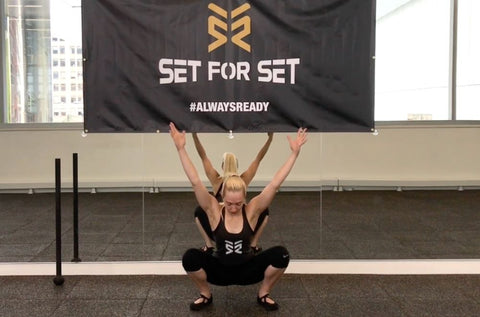
4. Overhead Deep Squat to Thoracic Rotations

This exercise combines a couple movements in one. It is a complex movement that is great for both getting warm and improving mobility. It will improve the range of motion in your hips and then your thoracic spine. By keeping your arms overhead, you will also be priming your body to sit up straight during the squat, which promotes good form, and you will be activating your shoulders.
Reps: 3
Tips:
- Start standing straight up with your arms overhead as best as you can.
- When you squat down, go deep.
- Put your elbows to your inner knees and actively press out to stretch your hip abductors.
- When you do the thoracic rotation, try to bring the top arm to a completely vertical position without rotating your hips.
5. Inch Worm to World’s Greatest Stretch to Hamstring Stretch to Downward Dog

This is another complex warm up movement that will get your blood flowing while improving your range of motion. This movement has multiple benefits in terms of target areas. It is going to stretch your back, hamstrings, hips, inner thighs, shoulders, thoracic spine, and even your calves.
Reps: 1 to each side
Tips:
- Start in a standing position and roll your spine down while keeping your knees straight if you can, so you can get a stretch in your hamstring.
- Slowly walk your hands out to a push up position.
- Bring your right leg to the side of your right hand, then shift your right arm up towards the ceiling.
- Hold this position for a few seconds, sink deeper into the stretch by pushing your hips towards the floor. You can bob a bit and make it more of a ballistic stretch.
- Then plant your hand back down and push your hips up to extend both legs. This will stretch your hamstrings again. Your back heel can stay up off the ground.
- From here, step your right leg back into downward dog, then march your feet in place. This will give your hamstrings and calves a nice dynamic stretch. Give a good 6-8 marches, 4 each side.
- After, step your left leg to the side of your left hand and continue to the world’s greatest stretch. So, you will only be doing the inchworm once.
6. Shoulder & Scapular Rotations
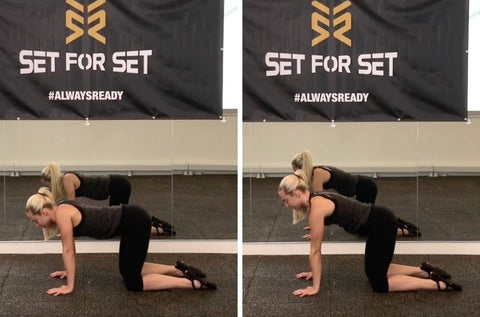
This is a simple exercise that is great for the shoulders and scapular (shoulder blades). It will help to loosen them up and stabilize the scapula.
Reps: 4 forward rotations, 4 backward rotations
Tips:
- Get on your hands and knees with your back straight.
- Keep your hands directly under your shoulders.
- As you roll your shoulders, really focus on the rotator cuff and shoulder blades. Connect your mind to them.
7. Thoracic Rotation to Thread the Needle
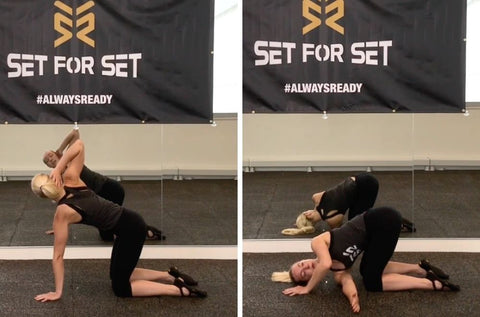
This exercise combines two movements. It’s going to stretch your thoracic spine your low back, and your shoulders.
Reps: 3 to each side
Tips:
- Get on your hands and knees with your back straight.
- Place your right hand on your ear and rotate your thoracic spine so that your elbow is pointing straight up. Keep your hips squared to the ground.
- As you rotate down, remove your hand from your ear and bring it under and straight across your body. You should come down into a cradle pose with your right arm under your body, right ear to the ground, thoracic spine rotated, hips squared forward, and butt up towards the ceiling.
- After you do one side for 3 reps, do the same on your left side.
8. Forearm & Grip Stretch

This exercise is straight forward. It is going to stretch your grip, which includes your hands, wrists, and forearms. While this is an important warm up movement for any workout that involves heavy use of your grip, it is especially important for workouts that heavily rely on grip.
Reps: 3
Tips:
- Place your hands in front of your knees about shoulder-width apart. Knees together, and get on your toes for an added foot stretch.
- Elbows straight and push your shoulders down and away from your ears.
- Lean your body forward, stop when the stretch is adequate and hold for a couple seconds then return to the starting position, that’s one rep.
9. Wrist Stretch

This is very similar to the movement above. However, your palms will be facing up. This way, you are focusing more on your wrists, rather than your forearms. It’s a great way to stretch and improve the stabilization of your wrists.
Reps: 3
Tips:
- The movement is the same as above, so follow the same movement pattern, just palms up.
- For this one, don’t put too much pressure on your wrists. A light stretch is enough.
- After you finish, do some wrist rolls to relieve some tension.
10. 90/90 Stretch

This classic hip-mobility exercise trains both internal and external hip rotation. It can help you move more comfortably through squats, lunges, and other lower-body exercises.
Reps: 3 to each side
Tips:
- Front leg at a 90-degree angle, back leg as well. Everything stacked.
- Sit tall and tuck your hips underneath. Make sure your rib cage is also down.
- Actively push your knees to the ground, using your hands to assist. Hold for 10 seconds.
- After, you will flip to the other side. For this, you push your feet into the ground and rotate at the hips. If you need help, you can plant your hands behind you. If not, you can keep your arms straight out in front of you.
And that’s it. 10 great dynamic warm-up exercises that will target your full-body. This is a great routine to do before any workout.
10 MINUTE FOLLOW ALONG DYNAMIC WARM UP ROUTINE
Follow along with Paulina Kairys as she goes through a highly effective 10 min dynamic bodyweight warm up. This is the perfect warm up that you can do at home or in the gym before any workout. It will loosen up your joints for optimal mobility, increase your heart rate & blood flow, and get your body temperature up so you can do an intense workout with a higher level of injury resilience and power output.
This 10 minute upper and lower body warm up includes exercises that will prime the following joints for mobility and stability:
- Ankles
- Knees
- Hips
- Shoulders
- Scapular
- Elbows
- Wrists
- Thoracic Spine/Neck
- Lumbar Spine
It will also dynamically stretch the muscles of both your upper and lower body, such as:
- Calves
- Hamstrings
- Quads
- Glutes
- Obliques
- Lats
- Forearms
- Shoulders/Rotator Cuff
Dynamic Exercises in the Warm Up (TIMESTAMPS):
- Lateral Reaches (0:13)
- Thoracic Rotations (0:44)
- Spinal Rolls (1:08)
- Overhead Deep Squat to Thoracic Rotations (2:15)
- Inch Worm to World’s Greatest Stretch to Hamstring Stretch to Downward Dog (3:13)
- Shoulder & Scapular Rotations (4:58)
- Thoracic Rotation to Thread the Needle (5:39)
- Forearm & Grip Stretch (6:51)
- Wrist Stretch (7:29)
- 90/90 Stretch (8:26)
Frequently Asked Questions
How long should a dynamic warm-up last?
Most people need 5-10 minutes. Longer or more technical sessions may require 10-20 minutes, especially before sprinting, heavy lifting, competition, or exercise in cold conditions.
Should you do static stretching before a workout?
Brief static stretching can be used when a specific area limits your movement, but prolonged passive stretching immediately before explosive exercise may temporarily reduce performance. Follow any static stretching with dynamic movement and exercise-specific practice.
Does warming up prevent injuries?
A warm-up cannot guarantee that you will avoid injury. However, structured warm-ups that include dynamic mobility, strength, balance, agility, and sport-specific drills may reduce injury risk while improving readiness.
Do you need to warm up before walking or light exercise?
For easy activity, the first few minutes can serve as the warm-up. Start at a comfortable pace and gradually increase your effort.
Should you warm up before every lifting exercise?
You do not need to repeat the entire dynamic sequence before every movement. Perform the full warm-up at the beginning, then use lighter practice sets when moving to a technically demanding or heavily loaded exercise.
Can a warm-up be too long?
Yes. A warm-up should leave you prepared, not tired. Reduce the volume if your strength, speed, or motivation begins dropping before the workout starts.
Final Thoughts
A good dynamic warm-up is short, purposeful, and specific to the work ahead. Start by raising your body temperature, move the relevant joints through a comfortable range of motion, activate the muscles you need, and finish by rehearsing the main activity at a lower intensity.
The 10 exercises in this routine cover the major joints and movement patterns used in most workouts. Use the complete sequence when you want a full-body warm-up, or select the movements that best match your session.
Don't Forget To Cool Down After Your Workout
Cooling down after a workout is important too! Make sure you don’t skip out on a cool down. Our favorite way to cool down is with a decompression flow.
Learn about cooling down after a workout and follow along to Paulina Kairys’ decompression flow!

References
- Li, F. Y., et al. “A Systematic Review and Network Meta-Analysis of the Effects of Different Warm-Up Methods on Explosive Performance.” BMC Sports Science, Medicine and Rehabilitation, 2023.
- Afonso, J., et al. “Revisiting the ‘Whys’ and ‘Hows’ of the Warm-Up.” Sports Medicine - Open, 2023.
- Esteban-García, P., et al. “Does the Inclusion of Static or Dynamic Stretching in the Warm-Up Improve Lower-Limb Performance and Range of Motion?” Applied Sciences, 2024.
- Sople, D., et al. “Dynamic Warm-Ups Play a Pivotal Role in Athletic Performance and Injury Prevention.” Arthroscopy, Sports Medicine, and Rehabilitation, 2025.
0 comments