


The upright row is a vertical pull used in weightlifting and physique programs to build the lateral delts, upper traps, and upper back. It works, but the combo of shoulder abduction plus internal rotation can be cranky for some shoulders. Below you’ll get safe-form cues, why it can irritate your shoulder, and nine smarter swaps that hit the same muscles.
Quick Answer
If upright rows bother your shoulders, first try a slightly wider grip, keep the bar or handles close, and stop around nipple to upper-chest height (no need to yank to your collarbone). If it still feels pinchy or sharp, swap it for dumbbell lateral raises, face pulls, TRX rows, or a power-based option like the high pull.
Take Your Fitness To The Next Level


Note: Pain that is sharp, lingering, or worsening is your cue to stop and get assessed by a qualified professional.
| Key takeaways | What to do |
|---|---|
| Main targets | Lateral delts, upper traps, rhomboids, biceps |
| Why it can irritate shoulders | Abduction plus internal rotation can reduce space in the shoulder and feel “pinchy,” especially with a close grip and pulling too high |
| Safer upright-row tweaks | Wider grip, stop at nipple to upper-chest, use dumbbells or cables, keep wrists neutral |
| Best swaps if you want delts | Dumbbell lateral raise and cable or band face pull |
| Best swaps if you want trap power | Barbell high pull or snatch pull |

9 Upright Row Alternatives
If the upright row bugs your shoulders or you just want variety, these nine alternatives cover the same “delts and traps” territory with friendlier joint angles and more options for grip and range of motion.
1. UNILATERAL DUMBBELL UPRIGHT ROW

The dumbbell upright row can be performed with one or two dumbbells. When holding one dumbbell, you can explore more comfortable ranges of motion due to the freedom of movement. It's better to work unilaterally to strengthen imbalances between sides and to put the shoulder joint at less risk while still training the same movement pattern.
How to:
- Grip the middle of the dumbbell handle with an upright posture, shoulders down and back with glutes and quads engaged.
- Pull the dumbbell up while taking the elbow up and out away from the body.
- Keep a firm grip on the dumbbell.
- Slowly return to the starting position.
- Do all your reps on one side and then repeat on the other.
2. TRX INVERTED ROW

The barbell inverted row is an upper back and biceps staple, but it locks you into a fixed grip. The TRX inverted row lets you adjust grip and wrist position on the fly, and the strap instability can boost core and scapular control. That combo tends to play nicer if you have wrist, elbow, or shoulder issues.
How to:
- Grip the TRX handles with your preferred grip and hang down directly under the TRX.
- Engage your glutes and upper back to form a straight line with your torso and keep your spine neutral.
- Pull your body up to the handles just below your chest.
- Slowly lower until your arms are straight. Reset and repeat for reps.
3. SNATCH PULL

The snatch pull trains lower and upper body power because the lower body is involved in driving the bar up. It resembles the “pull” part of an upright row but uses a wide snatch grip, which many lifters find friendlier on the shoulders. Since the legs and hips contribute, you can typically use more load than a strict upright row.
How to:
- Position your shoelaces under the bar with your feet hip-width apart, hinge down, and grip with a wide snatch grip.
- Keep your head up and your shoulder blades pulled together and back.
- Get tight and push through your legs with your chest up to lift the bar off the floor. Your chest and hips should rise together while keeping the bar close to your body.
- After the bar clears your knee, accelerate the barbell with your legs towards a standing position.
- As the bar reaches your hip, make strong contact and powerfully extend your hips and legs.
- Then powerfully pull your elbows up and back, keeping your knuckles pointed down throughout the pull.
- Return to the starting position, reset, and repeat.
4. BARBELL HIGH PULL

The barbell high pull is a great alternative because it targets similar muscles but adds hip drive. That momentum helps you move more weight and turns the lift into a power builder. Keep the pull to about elbow-to-shoulder height. There is no prize for yanking it higher if your shoulders hate it.
How to:
- Grip the bar with your regular upright row grip or a bit wider if this bothers your shoulders.
- Hinge your hips back and let the bar slide down your thighs.
- Once it reaches the top of your knees, powerfully drive your hips forward and pull the barbell up.
- As the bar travels up past your hips, pull your elbows up and back.
- Slowly return to the starting position, reset, and repeat.
5. UNILATERAL DUMBBELL SNATCH

The unilateral dumbbell snatch is a powerful single-arm move where the middle of the lift resembles the upright-row “elbow up” pattern. Like the snatch pull and high pull, it trains lower body drive and total-body power while still hammering traps and delts.
How to:
- Grip a dumbbell and set it on the floor horizontally.
- Place your feet on either side of the dumbbell about shoulder-width apart or in your preferred squat stance.
- Squat down, keep your chest up, and grip the dumbbell.
- Stand up and as the dumbbell reaches hip height, pull your elbow up and back.
- Get your arm under the dumbbell as it travels up. Think “punch the ceiling.”
- Reset and repeat.
- Perform the same amount of reps on the other side.
6. DUMBBELL LATERAL RAISE

When you want to train your lateral delts, look no further than the dumbbell lateral raise. This is a great alternative if the upright row bothers your shoulders. The lateral raise mostly trains the lateral deltoid, but if you take it above shoulder height, you’ll get some upper trap engagement too.
How to:
- Stand upright gripping a dumbbell in each hand at the side of your thighs.
- Keeping your elbows straight, lift the dumbbells directly out to your side.
- Stop when the dumbbells are slightly higher than shoulder height and pause for a second.
- Slowly lower down and reset and repeat for reps.
7. CABLE (OR BAND) FACE PULL

The cable or band face pull trains the upper back, deltoids, and biceps, making it a strong substitute. The external rotation at the end helps cue shoulders down and back, which is a nice antidote to “shruggy” posture. Keep it controlled and focus on feeling the upper back do the work.
How to:
- Raise the cable machine to chest height, attach a rope, and grip with a neutral grip with your arms straight.
- Keep your chest up, shoulders down, and look straight ahead.
- Pull the rope towards your ears.
- At the end, squeeze your shoulder blades together and bring your arms into external rotation.
- Slowly return to the starting position, reset, and repeat.
Related: Face Pull Alternatives
8. TRX YTW

The TRX YTW is basically three exercises in one and strengthens the upper back and traps from different angles without aggravating the shoulder joint. It also helps reinforce better posture and builds the rear delts and rotator cuff in the “W” portion.
How to:
- Take a firm grip on the handles below shoulder height and walk your feet in to your desired intensity.
- Keep your shoulders down and chest up throughout.
- Pull your arms into a Y shape overhead and slowly lower down.
- Pull into a T shape with your palms facing away and then slowly return to the starting position.
- Finally do a face pull and then externally rotate the shoulders into the W position.
- This is one round. Reset and repeat.
9. BARBELL OVERHEAD CARRY

Overhead carries put your whole body under tension and every step challenges balance and bracing. Start lighter, around 60% to 80% of your overhead press 1RM. Overhead carries give delts, upper back, and upper traps a long time under tension, making them a legit upright-row replacement even though there is no pulling.
Note: There are many other overhead carry variations (with dumbbells or kettlebells, unilateral or double) with similar benefits.
How to:
- Load the barbell with between 60% to 80% of your overhead press one-rep max.
- Place your hands slightly wider than shoulder-width and press the barbell overhead from the squat rack.
- Keep your biceps behind your ears and keep your chest up and shoulders down.
- Take slow, deliberate steps paying attention to your gait and balance.
- Walk for 20 to 40 yards.
- Re-rack the barbell in the squat rack.
- Rest and repeat.
What Is the Upright Row and How Do You Do It?
The upright barbell row is a vertical pulling exercise where the bar starts at arm’s length and you row it up toward the upper chest using your upper body. It also shows up inside Olympic lifting exercises, such as the clean and snatch.
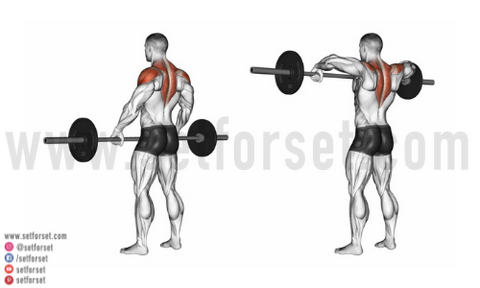
The upright row is usually performed with a shoulder-width grip, but grip changes shift the emphasis. A closer grip tends to hit shoulders more, while a wider grip tends to let traps contribute more.
Safer Upright Row Form Cues
- Grip: Start slightly wider than shoulder-width if close grip feels pinchy.
- Range of motion: Stop around nipple to upper-chest. Higher is not automatically better.
- Elbows: Think “up and slightly out,” not “crank straight up as high as possible.”
- Wrists: Keep them as neutral as you can. Cables and dumbbells help here.
- Tempo: Smooth on the way up, controlled on the way down.
Stand tall with the barbell at arm’s length by your waist, shoulders down and back, knuckles pointed toward the ground. Engage glutes and quads to keep your torso steady. Pull elbows up and out while keeping the bar close to your body until it reaches upper-chest height. Control the lowering and repeat.
Muscles and Movements Trained by the Upright Row
|
The upright row is mainly an upper-body exercise, with the core working hard isometrically so you can pull without turning the set into a standing wobble-fest.
Trapezius and other upper back muscles: The traps contribute heavily as the shoulder blades upwardly rotate and retract. The upper back helps keep posture tall and the bar close.
Deltoids: All three heads of the delts (anterior, middle, and posterior) assist, with the lateral head doing a lot of the “lift out and up” work.
Biceps: Elbow flexion helps you complete the pull, but if you feel it mostly in biceps, lighten the load and clean up the path.
Anterior and posterior core: The trunk and spinal stabilizers brace to keep you upright and efficient.
Why the Upright Row Can Hurt Your Shoulders
|
The upright row can build shoulders and traps, but it is not always kind to the shoulder joint, especially with a close grip or when you pull too high. In those positions, tissues in the shoulder can get irritated over time, even if it does not hurt immediately.
If you already have shoulder issues or limited mobility, you may do better with rows plus the alternatives below, while also improving shoulder mobility.
Related: How To Do Upright Rows Without Shoulder Pain
What Makes a Good Upright Row Alternative?
|
The prime movers with the upright row are:
- Lateral delts
- Upper traps
- Rhomboids
- Biceps
The upright row involves shoulder abduction and scapular upward rotation. Great alternatives keep those patterns, but give you more freedom to find a joint-friendly path and stop short of ranges that feel sketchy.
Programming Suggestions for the Upright Row Alternatives
|
Except for the overhead carry, here are simple guidelines for the other eight alternatives:
- Power-based lifts (high pull, dumbbell snatch, snatch pull): use a load you can move fast, keep reps lower, and do them earlier while fresh.
- Accessory and shoulder-health work (laterals, face pulls, TRX work): moderate loads, higher reps, and a controlled tempo after your main strength lifts.
Upright Row FAQs
Are upright rows bad?
Not automatically. They can be productive, but they are more likely to irritate shoulders for some lifters, especially with a close grip and pulling too high. If you feel pinching in the front or top of the shoulder, modify or swap.
How high should I pull on upright rows?
A good default is stopping around nipple to upper-chest height. If you can go higher without discomfort and maintain clean mechanics, fine. If it feels pinchy, stop lower.
Is a wide grip safer than a close grip?
Often, yes. A slightly wider grip can reduce the “cranked” shoulder position for many lifters. Dumbbells and cables can also feel better because the wrists and shoulders are not locked into one path.
What is the best upright row alternative for side delts?
The dumbbell lateral raise is the cleanest direct swap for lateral delt focus.
What is the best upright row alternative for traps?
If you want power and load, go with the barbell high pull or snatch pull. If you want joint-friendly posture work, use face pulls and TRX YTW.
Wrapping Up
The barbell upright row can build size and strength in your upper traps and shoulders, but it is not for everybody. If it irritates your shoulders, try the safer tweaks first. If that still does not feel right, these nine upright row alternatives can train the same muscles and movement patterns while being easier on the joints. Happy training.
Related Content:
- Pull Up Alternatives
- Lat Pulldown Alternatives
- Bench Press Alternatives
- Seated Cable Row Alternatives
- T-Bar Row Alternatives
0 comments