


Back extensions (often called hyperextensions) are one of the simplest, most effective ways to build a stronger lower back and posterior chain, especially when you do them slow, controlled, and mostly through a hip hinge. They train your spinal erectors (plus glutes and hamstrings) to extend and stabilize your spine, which can carry over to squats, deadlifts, and everyday “pick stuff up without feeling 80” tasks.
Key takeaways
|
Who this is for
Lifters who want a stronger lower back, better posterior chain endurance, and more resilience for hinges, squats, and sport.
Take Your Fitness To The Next Level


When to avoid (for now)
Skip loaded back extensions if you have sharp pain, new/worsening symptoms, or radiating pain, and talk with a qualified clinician first.

While the hyperextension bench is great, it’s not the only way to do back extensions, as you are going to see...
WHAT ARE HYPEREXTENSION EXERCISES?
A “hyperextension exercise” usually means a back extension done on a hyperextension bench (often a 45-degree Roman chair). You start in a flexed position and extend back up under control.
One important nuance: the term hyperextension technically means moving a joint past its normal range. In practice, most lifters are simply working through a normal and comfortable spine and hip range. Typical lumbar extension values are commonly reported around the mid-20s to mid-30s degrees, depending on the reference and the person, and your hips and upper back contribute a lot to what you see as “how far you’re moving.”
Bottom line: You do not need to chase an extreme “bend back” position. A clean rep that finishes around neutral or slightly past neutral (if comfortable) is plenty.

What are hyperextensions extensions good for?
The main purpose of a back extension (no matter what you are using) is to strengthen the lower back. It's a staple in lower back workouts.
What muscles do back extensions work?
The main muscle targeted with back extensions is the erector spinae. The erector spinae is a long muscle that runs up the entire length of the spine. Obviously, you have one on each side of your spine. The main function of the erector spinae is spinal stability.
The erector spinae itself is comprised of 3 smaller muscles:
- Spinalis
- Longissimus
- Iliocostalis
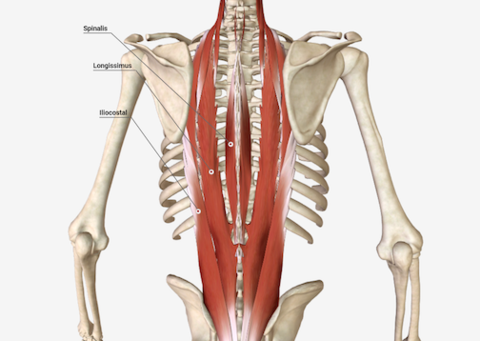
So, when doing back extensions, you will be strengthening all of these muscles.
You will also get meaningful work from:
- Glutes
- Hamstrings
- Deep stabilizers (including multifidus) depending on the variation and technique
Do they work abs?
Yes, your trunk muscles co-contract to stabilize your torso, especially when you slow the tempo and avoid swinging.
BENEFITS OF BACK EXTENSIONS
With back extensions obviously comes a stronger and more mobile back, which is why we've included this exercise in our back day workout. However, there are other benefits as well.
Here are the overarching benefits of performing back extensions on a regular basis:
- Spinal and trunk endurance (the “don’t fold on rep 8” factor)
- Better posture and positional strength in hinges and squats
- More posterior chain capacity without the recovery cost of heavy pulls
- Resilience when life forces you into awkward positions (groceries, kids, luggage, moving day)
Exercise is commonly recommended as part of management for many people with persistent low back pain, though the “right” exercise depends on the person and presentation.
How often should I do back extensions?
You can do back extensions twice a week. Ideally you can get around 6 sets in per week and that’s enough. Be sure to do them after you are fully warmed up.
Back extensions vs reverse hypers: which is better?
They train similar areas, but they feel different and can be better for different goals.
Research comparing reverse hyperextension (RHE) and hyperextension (HE) variations shows strong posterior chain involvement in both. Some findings suggest reverse hypers can produce higher EMG in several posterior chain muscles in certain conditions, and biomechanical work shows meaningful differences in loading and movement demands.
Practical choice guide
Choose back extensions if:
- You want a simple, widely available way to strengthen spinal erectors
- You want a big “posterior chain burn” with minimal setup
Choose reverse hypers if:
- You want posterior chain work while minimizing lumbar flexion exposure
- You respond better to hip-dominant movement and controlled swing-free reps
CAN HYPEREXTENSIONS HURT YOUR BACK?
They can if you do them sloppy, rush reps, or load them like an ego lift. The movement itself is not the villain.
Form rules that keep people out of trouble
- Move slow and controlled (no bouncing at the bottom)
- Think “hinge” first, not “crank my spine”
- Keep your ribs down and core braced
- Finish tall, do not chase a big lean-back
- Stop a set when reps get sloppy
Are weighted back extensions bad?
No, but load them like any other lift: gradually. Add reps first, then tempo, then load.
WHAT ARE EXAMPLES OF BACK EXTENSION EXERCISES?
There are many ways that you can do back extensions (and reverse hyperextensions). Below, we are going to show you 18 examples of back extension exercises. We have categorized them as follows:
- Back Extensions on Hyperextension Bench
- Back Extensions on Bench
- Back Extensions on Floor
- Back Extensions on Stability Ball
- Back Extensions with Bands
- Back Extensions with Suspension Trainer
- Reverse hyperextensions using various implements.
- Lumbar Extension Articulation
These categories include weighted and non-weighted back extensions.
With everything, you will be able to do back extensions at home, at the gym, at the park, or wherever else you like to workout.
18 BEST HYPEREXTENSION BACK EXERCISES
Here are 18 hyperextension exercises that will be highly effective at strengthening your erector spinae, hamstrings, and glutes. Some variations will also activate other muscles not specifically targeted by standard back extensions/hyperextensions.
Hyperextension Bench:
Back extensions on a hyperextension bench is very basic yet very effective, which is why most people just do back extensions using a hyperextension bench. Every single gym will have one of these, so if you are a gym go-er, this should be a staple in your low back exercise arsenal.
1. Prisoner Hyperextension
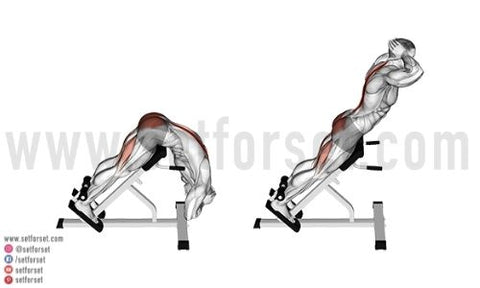
This version of the hyperextension involves keeping your hands behind your head and moving through full flexion. This simply increases the difficulty of the movement and activates the upper back and shoulders more.
It is called the Prisoner Hyperextension because of the way your hands are placed behind your head.
- Position yourself on the hyperextension bench so that your thighs are prone on the pads and the back of your lower legs are secured against the lower pads. The top of the bench should be just about hip level.
- Lower your upper body by bending at the hips until your torso is almost vertical.
- Raise your body back up until your hips and waist are extended.
- Pause for a moment at the top and squeeze your glutes and hamstrings to full contraction.
- Repeat.
Note: Your neck and head should always remain aligned with your spine. Don’t bend it backward.
Alternative Hyperextension Bench/Machine
Just for reference, your gym might have a hyperextension machine like this, which is ultimately the same thing, albeit a little more difficult.

2. 45-Degree Hyperextension

This version of the hyperextension is a little easier than the previous one as you will have your hands crossed at your chest and you will only lower your upper body down until your legs and torso make a 90˚ angle. This means your spine will remain straight at all times.
- Position yourself on the hyperextension bench so that your thighs are prone on the pads and the back of your lower legs are secured against the lower pads. The top of the bench should be just about hip level.
- Lower your upper body by bending at the hips until your torso is about at 90˚ with your legs.
- Raise your body back up until your hips and waist are extended.
- Pause for a moment at the top and squeeze your glutes and hamstrings to full contraction.
- Repeat.
Note: You can make this hyperextension exercise harder by holding a weight plate at your chest as seen below.
Weighted Hyperextension
3. Single Leg Hyperextension

This is the same as the hyperextension above, but you only have one leg secured. This makes a big difference as it significantly increases the activation of the hamstrings.
- Position yourself on the hyperextension bench so that your thighs are prone on the pads and the back of your lower legs are secured against the lower pads. The top of the bench should be just about hip level.
- Lower your upper body by bending at the hips until your torso is about at 90˚ with your legs.
- Raise your body back up until your hips and waist are extended.
- Pause for a moment at the top and squeeze.
- Repeat.
Note: You can make this hyperextension exercise harder by holding a weight plate at your chest. However, because you are using just one leg, additional weight is not really recommended. The weight of your body will be enough, at least for quite some time.
4. Twisting Hyperextension

The twisting hyperextension targets your obliques to a high degree as well as your spinal erectors.
- Position yourself on the hyperextension bench so that your thighs are prone on the pads and the back of your lower legs are secured against the lower pads. The top of the bench should be just about hip level. Your hands will be on the back of your head in a “prisoner” position.
- Lower your upper body by bending at the hips until your torso is a little past 90˚ ROM.
- Raise your upper body back up while simultaneously rotating your chest and shoulders to the side. Don’t rotate/twist more than is comfortable. It should be within a natural range of motion.
- Pause for a moment at the top and squeeze.
- Repeat.
Note: Your upper body will rotate, but your head and neck will remain aligned with your chest. There should be no reason to twist your neck. The twist will occur at your core.
5. Hyperextension with Resistance Band

This is essentially the same as holding a plate when doing a hyperextension. However, the band provides a different kind of tension. The elastic tension means the resistance will increase the more it stretches (so as you raise your body back up, the resistance will continue to increase).
This is great as it provides more resistance at the top of the extension (when the movement starts to get easier) and less at the bottom (when the movement is hardest).
Moreover, the band requires you to move slowly and controlled during flexion, to resist the band from just pulling you down.
This helps to eliminate any jerky or fast motions, which is most common during flexion on a hyperextension. It also increases activation of the targeted muscles.
- Loop the band around the beam that connects the base of the hyperextension bench to the bench. Position yourself on the hyperextension bench so that your thighs are prone on the pads and the back of your lower legs are secured against the lower pads. The top of the bench should be just about hip level. Hold the band at chest level in a prayer-like position.
- Lower your upper body by bending at the hips until your torso is a little past 90˚ ROM.
- Raise your body back up until your hips and waist are extended.
- Pause for a moment at the top and squeeze.
- Repeat.
Standard Bench:
If you don’t have access to a hyperextension bench or you simply want to try different variations of back extensions, the standard bench can be an effective way to do back extensions.
It’s similar to doing back extensions on the floor, but you’ll have more range of motion for flexion.
6. Back Extension on Flat Bench

This is going to work all the same muscles as a back extension on a hyperextension bench.
To do this exercise, you either need someone to hold your feet down OR you can simply lock your feet under the bench with your heels (which will place your thighs on the sides of the bench a little for grip as well). Assuming you won’t have a partner, we will use the latter method in the 'how to' below.
- Place your hips down to the end of the bench in prone position. The bench should end just at hip level.
- Lock your heels underneath the bench and use your inner thigh to grip the bench.
- Cross your arms at your chest or place them behind your head in a prisoner position.
- Lower your upper body down until your face comes close to the floor (keep your head and neck straight).
- Raise back up until your hips are fully extended. You should be able to get about 20-30˚ of extension in your low back.
- Repeat.
Floor: Don’t have a hyperextension bench or a standard bench? NO WORRIES. Back extensions can be done on the floor with just your bodyweight, and YES, they are very effective.
7. Back Extension on Floor

Back extensions on the floor work all the same muscles as the hyperextension bench. One of the notable differences is you will be raising your feet up as well as you will really maximize extension. Furthermore, you will not be performing spinal flexion, which is good for those who have issues with their low back.
There are three ways you can position your arms. You can use the prisoner position, arms extended in front of you (superman position), or arms at about 45 degrees with your hands next to your head.
- Get into a prone position on the floor with your legs fully extended and together and your hands behind your head (or the other positions we mentioned above).
- Simultaneously lift your legs and your chest up off the floor to perform spinal extension. Try your best to maximize extension, but don’t push yourself too far. You don’t want to overextend.
- Squeeze your legs, glutes and back and hold the position for 1 or 2 seconds then very slowly lower back down to neutral.
- Repeat.
Essentially this exercise is a combination of a reverse hyper and a back extension.
Back Extension on Floor (Easy)

This is simply an easier version of the floor back extension. Rather than bringing your legs up, you will just lift your chest off the ground. Also, your hands will be placed down to your sides.
We recommend this for very beginners or people who have back issues or are trying to rehab their lower back.
8. Resistance Band Floor Back Extension

If you have mini bands, you can wrap them around your legs and arms (or just your legs or arms) and perform the exercise as seen in the pic. This simply helps you to maximize activation of the muscles and it also brings your shoulders, upper back and hip abductors into play to a higher degree.
Stability Ball:
The stability ball back extension provides more core activation than the other versions we’ve went through because as the name of the product suggests, you need to maintain stability when using it.
With the stability ball, you will get a fair amount of spinal flexion and you can really maximize extension in a safe way thanks to the flexibility of the ball.
Overall, it’s a very unique way to do back extensions and its definitely worth implementing into your routine at some point.
9. Stability Ball Back Extension

While this exercise is demonstrated using a weight plate, beginners should first do stability ball hyperextensions with just their bodyweight.
- Place your hips on the stability ball and position yourself so your upper things and lower core are wrapped around the ball as well. This means there will be more contact for the torso than there is with a hyperextension bench and regular bench. With that, performing flexion will be easier on your back.
- It’s best to plant the balls of your feet into the floor for stability purposes but you can place the tops of your feet on the floor as well if you want a little more challenge.
- Lower your chest down until it touches the ball. Your body will essentially be wrapping around the stability ball.
- Raise your chest up until your spine moves past neutral. Only extend past neutral as far as you are comfortable. There should be tension in your low back, but not pain.
- Squeeze your glutes at the top and then slowly lower back down.
Note: Remember, this is a slow and controlled movement. Keep your core tight throughout to maintain stability.
Bands:
If all you had was a resistance band (41” loop resistance band) you could still do back extensions, and effectively so.
10. Band Hyperextension

You will be doing back extensions with bands from a standing position. Essentially, the movement is exactly the same as a stiff-leg deadlift. The only difference is the tension will be coming from down and out in front of you rather than directly below you. This places more tension on your lower back.
- Anchor the band to a low point near the floor.
- Stand with your feet close together. Your legs will be extended throughout the movement, but you can have a very slight bend in your knee.
- Step away from the anchor so the band is taut and hold the band with both hands down right at about hip level.
- Lower your upper body down while shooting your hips back, just like you would a stiff-leg deadlift.
- Go down until your body is past 90˚. Your arms will move out forward and come close to the floor.
- Lift your upper body up while maintaining a straight spine.
- As you come up, push your hips forward and stop when your hips are fully extended. You will be leaning slightly back.
- Repeat.
Note: Move slow and controlled for the entire movement. It’s essentially the same mechanics as a stiff-leg deadlift except you will be slightly exaggerating the extension at the top.
Suspension Trainer:
This is definitely not your standard back extension. It will take some time to get the mechanics down for back extension with a suspension trainer. However, it is not a particularly difficult exercise. So, move slowly and controlled and really focus on good form.
11. Suspension Back Extension
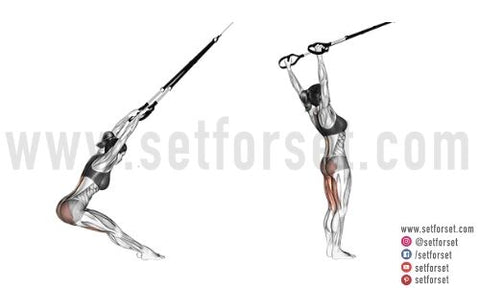
Suspension trainer back extensions work your erector spinae, glutes and hamstrings just like any other back extension. With this exercise you can simply come up from the flexed position to neutral or you can lean slightly back with your arms raised overhead at the top of the movement for a little extra spinal extension.
- Grab the handles of the suspension trainer and raise your arms up straight overhead. Step back so the suspension training is almost taut. Keep your feet close together but not touching. Your legs will remain straight throughout the movement.
- Hinge back at the hips (you can roll onto your heels or keep your feet to the floor if you have the ankle mobility to do so). As you hinge back into the L position keep your head between your arms.
- The suspension trainer will be full taut in this L position. From here, hinge your hips forward while simultaneously raising your arms up overhead until you reach the standing position.
- You will not go past neutral. Just stand straight up then repeat.
Note: Move slowly and controlled at all times. Don’t rush through the movement.
REVERSE HYPEREXTENSIONS:
Now that we have went over all of the back extensions, look go over a several examples of reverse hyperextensions.
The best way to do reverse hyperextensions is with a reverse hyperextension machine as seen in this pic.
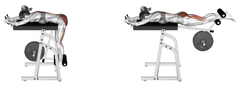
However, the vast majority of gyms don’t have this machine. So, we will show you examples of reverse hypers with more accessible tools.
12. Reverse Hyper on Flat Bench
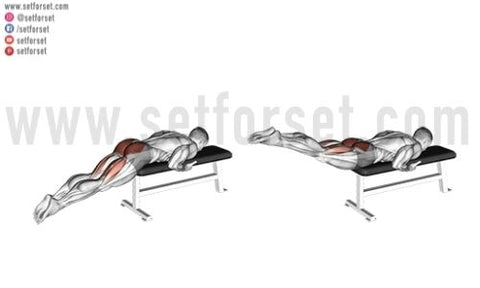
This is like the back extension on a flat bench but instead of having your upper body off the bench, your lower body will be off the bench.
- Position your body so the bottom of your hips is at the end of the bench. Grab the sides of the bench with your hands to keep your body fixed to the bench.
- Lower your legs down while keeping them straight and together.
- When your toes are just about touching the floor, lift them up as high as you comfortably can. Your legs will remain fully extended throughout the exercise.
- Squeeze your glutes at the top and repeat.
13. Frog Reverse Hyperextension

You can also try this same exercise with your legs in a front position, which means they are bent at 90˚ with your heels touching.
14. Reverse Hyperextension with Resistance Band

If you want more glute activation, try wrapping a fabric mini band around your lower quads and perform the exercise as you normally would, just be sure to press your legs out to maintain tension on the band.
15. Incline Reverse Hyperextension

If you want even more range of motion, set the bench to incline! Just be sure that the bench is high quality so you don’t have to worry about it breaking with all the weight of your body on the back rest.
16. Smith Machine Reverse Hyperextension

For this exercise, your body will be in a very similar position as the frog reverse hyper on a flat bench. Your feet will just be spread apart. What this exercise offers is additional resistance.
So, basically, it’s just a weighted version of a flat bench reverse hyper. As such, you should save it for when you advance a little more (or if you are already strong, give it a go right away!).
Related: 10 Smith Machine Exercises You Should Be Doing
17. Stability Ball Reverse Hyper

This is the opposite of the stability ball back extension, so your hands will be planted on the floor and your legs will be moving up and down. Like the stability back extension, the stability ball reverse hyper will demand a lot of core stability in addition to the hamstring, glute and low back activation.
Related: Reverse Hypers Exercise Guide & Variations
18. LUMBAR SPINE EXTENSION ARTICULATIONS

This is a great stretching and mobility exercise for your spine. Essentially, you are trying to extend your lumbar spine one vertebrae at a time, so you will be extending back very slowly. Try to reach maximum extension, which is about 30˚.
CAN YOU DO BACK EXTENSIONS EVERYDAY?
There’s no need to do back extensions everyday. If you want to strengthen your lower back, then try to do back extensions 2 times a week for a total of 6-8 sets. This should be plenty of volume. The muscles in the lower back are quick to recovery, so you can do them more frequently than bigger muscle groups like the quads or pecs.
Related: Best Back Extension Alternatives
HOW TO IMPLEMENT BACK EXTENSIONS INTO YOUR TRAINING PLAN?
It really depends on your split. If you do a body part split (aka bro split) then you can hit a few sets of back extensions on back day and leg day, preferably towards the end of your sessions.
If you do an upper lower split, then you may prefer to do them on lower body days because typically lower body days involve less exercises than an upper body day (considering there are less muscles to hit). If you do a PPL split, then you could do them on either pull or leg day.
Another option is to do back extensions like you do core exercises.
Maybe you simply throw them into any workout at the end of your session with your core exercises. There is no right answer here, but if you hit back extensions one day, then you should give a day or two rest before hitting it again.
As for which back extension exercises, you can switch them up as back extensions are an accessory or assistance lift, not a main lift.
So, maybe you choose two of the exercises above and do them for a month then after a month you switch to another two OR maybe you choose 4-8 and you rotate them monthly.
Try as many of these as you can and see which one targets the muscles best for you. If an exercise is effective, then use it for a while. Just be sure to add some variety over the course of your training.
Let us know what you favorite back extension exercises are in the comments below and also feel free to share how you incorporate them into your training (which days, sets, reps, etc.).
More Back Exercises:
- Best Bodyweight Back Exercises
- Best Resistance Band Back Exercises
- Best Dumbbell Back Exercises
- Best Barbell Back Exercises
- Best Upper Back Exercises
- Best Erector Spinae Exercises
- Best Rhomboid Exercises
- Best Trapezius Exercises
- Best Latissimus Dorsi Exercises

3 comments
these exercises have been very helpful. I am 81 I have been grooming dogs since 1976. I am not ready to retire.
these exercises have been very helpful. I am 81 I have been grooming dogs since 1976. I am not ready to retire.
these exercises have been very helpful. I am 81 I have been grooming dogs since 1976. I am not ready to retire.