


Once you've built solid technique with a lighter mace, moving up in weight can open the door to a very different style of steel mace training. A heavier mace increases the leverage, grip demand, trunk stiffness, and total-body strength required to control each repetition.
This guide explains what counts as a heavy steel mace, how heavier maces differ from lighter ones, when to use them, and how to program them safely. You'll also get a complete heavy mace workout that combines swings, circuits, complexes, and conditioning.
Important: Heavy steel mace training is not for complete beginners. Before moving into 20-30 lb maces, you should already be comfortable with basic mace positions, 360s, 10-to-2s, presses, rows, lunges, and bracing with a lighter mace.

Heavy Steel Mace Training At A Glance
| Category | Recommendation |
| Typical Heavy Mace Range | 20-30+ lb for experienced users |
| Best For | Strength, grip, rotational control, carries, swings, and conditioning |
| Experience Level | Intermediate to advanced |
| Good Starting Frequency | 1 heavy mace session per week |
| Main Risk | Using more load than your technique and joints can control |
| Key Progression | Increase weight only after movement quality is consistent |
How Heavy Is A "Heavy" Steel Mace?
There is no universal cutoff because the same mace can feel very different depending on your size, strength, grip, and experience.
For one person, a 15 lb mace may be extremely demanding. For another, 20 lb may feel moderate. In practice, we consider 20, 25, and 30 lb maces heavy options for most recreational lifters.

The number on the mace does not tell the whole story. A mace is an offset implement, which means the farther the weight sits from your hands, the more torque you have to control.
That is why a 20 lb mace can feel far more demanding than a 20 lb dumbbell.
Heavy Steel Mace vs Lighter Steel Mace
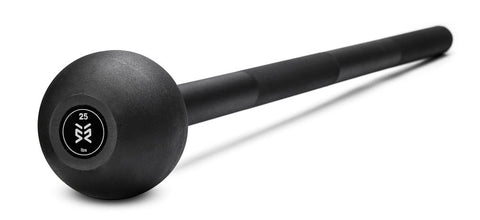
Heavier maces usually have longer, thicker handles and larger heads. Those changes matter because they increase leverage and grip demand in addition to simply adding weight.
For swings such as the 360 and 10-to-2, a longer handle can make the movement feel smoother once you have the strength and technique to control the implement. More mass also creates greater momentum, which can help the swing feel fluid but can become harder to decelerate when technique breaks down.
A lighter mace is often better for:
- Learning technique
- Warm-ups
- Longer-duration flows
- Skill practice
- Higher-repetition conditioning
- Mobility-focused work
A heavier mace is often better for:
- Lower-repetition strength work
- Heavy 360s and 10-to-2s
- Rows and presses
- Squat and lunge variations
- Loaded carries and isometrics
- Anti-rotation training
- Shorter, more demanding complexes
At SET FOR SET, our 10 lb and 15 lb Steel Maces use longer handles than many traditional light maces, which helps them feel more natural during swinging movements.
Heavy Mace History And Traditional Gada Training
The modern steel mace is related to the gada, a traditional club used in South Asian wrestling and physical culture. Heavy gada training has long been associated with wrestlers because swinging and controlling a long lever challenges the shoulders, grip, trunk, and upper body in a way that transfers well to grappling.
Very heavy gadas are still used by advanced practitioners, sometimes reaching weights far beyond what most recreational lifters would ever need.
That historical context is interesting, but it is not a reason to rush into extremely heavy mace training. Traditional wrestlers often spent years developing the skill and work capacity needed to handle those loads.

Benefits Of Heavy Steel Mace Training
1. More Grip And Forearm Demand
A thicker handle and greater leverage can make the grip work significantly harder. That is especially noticeable during swings, carries, rows, presses, and offset holds.
2. Greater Trunk And Anti-Rotation Demand
Because the mace head sits away from your center of mass, heavier loads create stronger rotational and side-bending forces. Your trunk must resist those forces to keep the movement controlled.
This is why heavy mace exercises can pair well with anti-rotation exercises.
3. Strength Through Unusual Leverage
A heavy mace does not replace barbells or dumbbells for maximal strength, but it gives you a different form of resistance. The challenge comes from controlling leverage rather than simply lifting a balanced load.
4. Rotational Strength And Control
Heavy swinging patterns can train the ability to produce and control rotational force. This can be useful for athletes, grapplers, and anyone who wants more multiplanar strength.
For lighter and more technical rotational drills, see our rotational steel mace exercises.
5. Lower-Body And Full-Body Loading
Heavier maces can make lower-body training and mace squat variations considerably more challenging without requiring a barbell.
6. Muscular Endurance And Conditioning
Heavy mace circuits can raise heart rate quickly because the same exercises often involve the grip, upper body, lower body, and trunk at once.
However, the heavier the mace, the more careful you need to be with fatigue. Heavy dynamic training performed under poor control is not a badge of toughness.
Heavy Mace vs Light Mace: Which Should You Use?
| Goal | Better Starting Choice |
| Learn 360s and 10-to-2s | Light to moderate mace |
| Warm-Up | Light mace |
| Flows | Light to moderate mace |
| High-Rep Conditioning | Light to moderate mace |
| Heavy Swings | Moderate to heavy mace |
| Heavy Rows / Presses | Heavy mace |
| Loaded Carries / Isometrics | Heavy mace |
| Anti-Rotation Training | Moderate to heavy mace |
There is plenty of overlap. The same movement can be used with several mace weights depending on your goal.
How To Progress To A Heavy Steel Mace
Do not jump from a 10 lb mace to a 25 or 30 lb mace simply because you can complete a few 360s.
Before moving up, you should be able to:
- Perform controlled 360s and 10-to-2s with both hand positions
- Maintain a neutral, controlled trunk during offset work
- Press and row without excessive leaning
- Complete mace squats and lunges with stable foot and knee positions
- Control the mace during the entire eccentric and deceleration phase
- Train without joint pain during or after the session
When you increase mace weight, reduce your repetitions and total volume at first. Let your grip, shoulders, elbows, and trunk adapt before pushing density or conditioning.
How Often Should You Train With A Heavy Mace?
The original version of this article suggested a 1-to-1 ratio of heavy to light mace sessions and even gave an example of six mace workouts per week. That can be excessive for many lifters.
A better starting point is:
| Experience | Heavy Mace Frequency |
| New To Heavy Maces | 1 session per week |
| Intermediate | 1-2 sessions per week |
| Advanced / Mace-Specialized | 2-3 sessions per week if recovery is good |
You can still use lighter mace sessions between heavy days for technique, flows, or easier conditioning. The exact ratio should depend on your total training load rather than a fixed rule.
Heavy Steel Mace Workout For Strength & Conditioning
This workout combines four different formats: heavy swings, a timed circuit, a complex-style flow, and a conditioning finisher.
Because it is demanding, scale the weight and volume to your experience. If 100 heavy 360s and 100 heavy 10-to-2s would compromise your technique, cut the repetitions in half or use a lighter mace for Part 1.
Workout Details
Target: Strength, muscular endurance, conditioning, grip, and calorie expenditure
Equipment: 20-30 lb steel mace for experienced users; lighter loads are completely acceptable
Skill Level: Intermediate to Advanced
Duration: Approximately 30-45 minutes depending on rest and scaling
Warm-Up
Use a general dynamic warm-up followed by several lighter mace-specific sets. Research on resistance-training warm-ups supports progressively preparing for the exact movement and load you are about to perform rather than relying on stretching alone.
Follow this Dynamic Warm Up before the workout, then rehearse your swings, presses, squats, and lunges with a lighter mace.
Part 1: Swing Workout
Original prescription:
100 x Mace 360
100 x Mace 10-to-2
Do not force yourself to complete all 200 repetitions without rest. With a genuinely heavy mace, quality matters more than uninterrupted volume.
Suggested scaling:
- Beginner to heavy mace work: 25-50 reps of each
- Intermediate: 50-75 reps of each
- Advanced: Up to 100 reps of each if technique stays consistent
Break the reps into sets as needed.
Part 2: Circuit Workout
2 rounds:
- Vertical Front Presses in Lunge Formation
- 360 to Offset Curl
- Reverse Lunge with Bayonet Strike
- Grave Diggers
Work for 30 seconds and rest 20-30 seconds between exercises. After all four exercises, rest 60-90 seconds before starting the second round.
Switch the targeted side in Round 2 so both sides receive similar work.
Part 3: Heavy Mace Complex
The original video calls this a flow, but with a heavy mace and repeated predetermined movements it is more accurately described as a complex.
Combine:
- 360
- Switch Squat
- Switch Lunge
- Offset Overhead Press
Original prescription: 5 minutes continuous.
For a heavy mace, continuous five-minute work may be unnecessarily fatiguing. A better option for many lifters is 3-5 rounds of 45-60 seconds with 30-60 seconds of rest.
Part 4: Conditioning Finisher
AMRAP for up to 10 minutes:
5 x Burpees
10 x Offset Bent Over Rows (5 each side)
Complete as many quality rounds as possible. Stop the set when fatigue causes your row position, grip, or burpee mechanics to break down.
You can also reduce the finisher to five minutes if the earlier sections were already demanding.
Rest Between Workout Parts
Rather than taking "as little rest as possible," use enough rest to restore good technique. For most people, 2-3 minutes between major sections is reasonable.
A strength-and-conditioning workout should challenge you, but turning every section into a maximal fatigue test can reduce movement quality without adding meaningful benefit.
Cool-Down
After the workout, gradually lower your effort and use any mobility work that feels useful. A formal cool-down is optional, but our decompression flow can be a good way to transition out of the session.
Best Heavy Steel Mace Workout Formats
- Complexes
- Conventional Strength Training
- 360s and 10-to-2s
- AMRAP
- EMOM
- Circuit Training
- Metabolic Workouts
- Isometrics
Best Lighter Mace Workout Formats
- Warm-Ups
- Rehab / Prehab
- HIIT
- Flows
- Isometrics
- Complexes
- Metabolic Workouts
- AMRAP
- EMOM
- Tabata-style intervals

There is plenty of overlap between heavy and light mace training. The difference is usually how you manipulate load, repetitions, work intervals, rest, and exercise complexity.
Common Heavy Mace Training Mistakes
Going Heavy Before Your Technique Is Ready
More weight magnifies technical mistakes. If you cannot control a movement with a lighter mace, the answer is not a heavier mace.
Chasing Fatigue Instead Of Strength
Heavy mace work does not need to leave you destroyed. Longer rest and lower reps are often better when strength is the priority.
Using The Same Weight For Every Exercise
Your ideal 360 weight may not be your ideal overhead-press or flow weight. Use different maces when necessary.
Ignoring Elbows, Wrists, And Shoulders
Heavy leverage can irritate joints when load increases too quickly. Reduce volume or weight when discomfort begins instead of waiting for it to become a problem.
Doing Heavy Mace Sessions Too Often
More frequency is not automatically better. Heavy mace sessions compete with your other strength and conditioning work for recovery.
Frequently Asked Questions
What weight counts as a heavy steel mace?
For many lifters, 20-30 lb is a useful heavy range, but the answer depends on your size, experience, and the exercise. A 15 lb mace can be very heavy for a newer user.
Are heavy steel maces better for 360s?
A somewhat heavier mace with a longer handle can make the swing feel smoother because it carries more momentum, but only if you can control the movement. Beginners should learn the pattern with a lighter mace first.
Can heavy mace training build muscle?
Yes, especially in the forearms, shoulders, upper back, arms, and trunk, provided the exercises are sufficiently challenging and progressively overloaded. For maximal hypertrophy, conventional resistance training may still be easier to load and quantify.
How often should I use a heavy mace?
One heavy session per week is a good starting point. Experienced mace users may tolerate two or three sessions depending on total training volume and recovery.
Can beginners use a 20 lb mace?
Most complete beginners should start lighter. Learning to control leverage and momentum matters more than proving you can move a heavier implement.
Should I do 100 heavy 360s?
Only if your experience and technique support that volume. There is nothing magical about 100 reps. Lower volumes performed with excellent control are often more appropriate.
Is a heavy mace good for conditioning?
Yes, but heavy mace conditioning should be carefully programmed. Short complexes, carries, and circuits work well, while very long high-rep sets can cause technique to deteriorate.
Final Thoughts
Heavy steel mace training can add a unique strength and conditioning challenge once you have mastered lighter mace work.
The benefit does not come from simply owning the heaviest mace possible. It comes from using a load that forces you to control leverage, momentum, rotation, and full-body tension without sacrificing technique.
Start with one heavy session per week, keep your early volume conservative, and build gradually. Use lighter maces for skill work, flows, and higher-repetition training, and save your heavier mace for the movements where additional load actually improves the training stimulus.
Should I buy a heavy mace? The Case For a Heavier Mace by Jan Libourel (78 year old mace enthusiast)
Let us know your favorite steel mace weight in the comments below.
0 comments